Chapter 2: The Crossing
Imagine standing on the docks at Belfast or Newry, looking out at a wooden ship that would be your home for the next two months. We don’t know exactly which port our McGinnis ancestor sailed from, but Belfast and Newry were the busiest for Ulster emigrants, and the McGinnis name was most common in nearby County Down. Behind you: everything you’ve ever known. The farm. The church. The graves of your parents. Ahead: a voyage across 3,000 miles of open ocean to a land you’ve only heard described in letters and pamphlets.
You’ve sold your small landholding to pay for passage. You’ve packed what you can carry. You’ve said goodbye to neighbors you’ll never see again.
This was the choice tens of thousands of Ulster families made in the 1700s. And somewhere among them, sometime in the early to mid-eighteenth century, a McGinnis made that choice too.
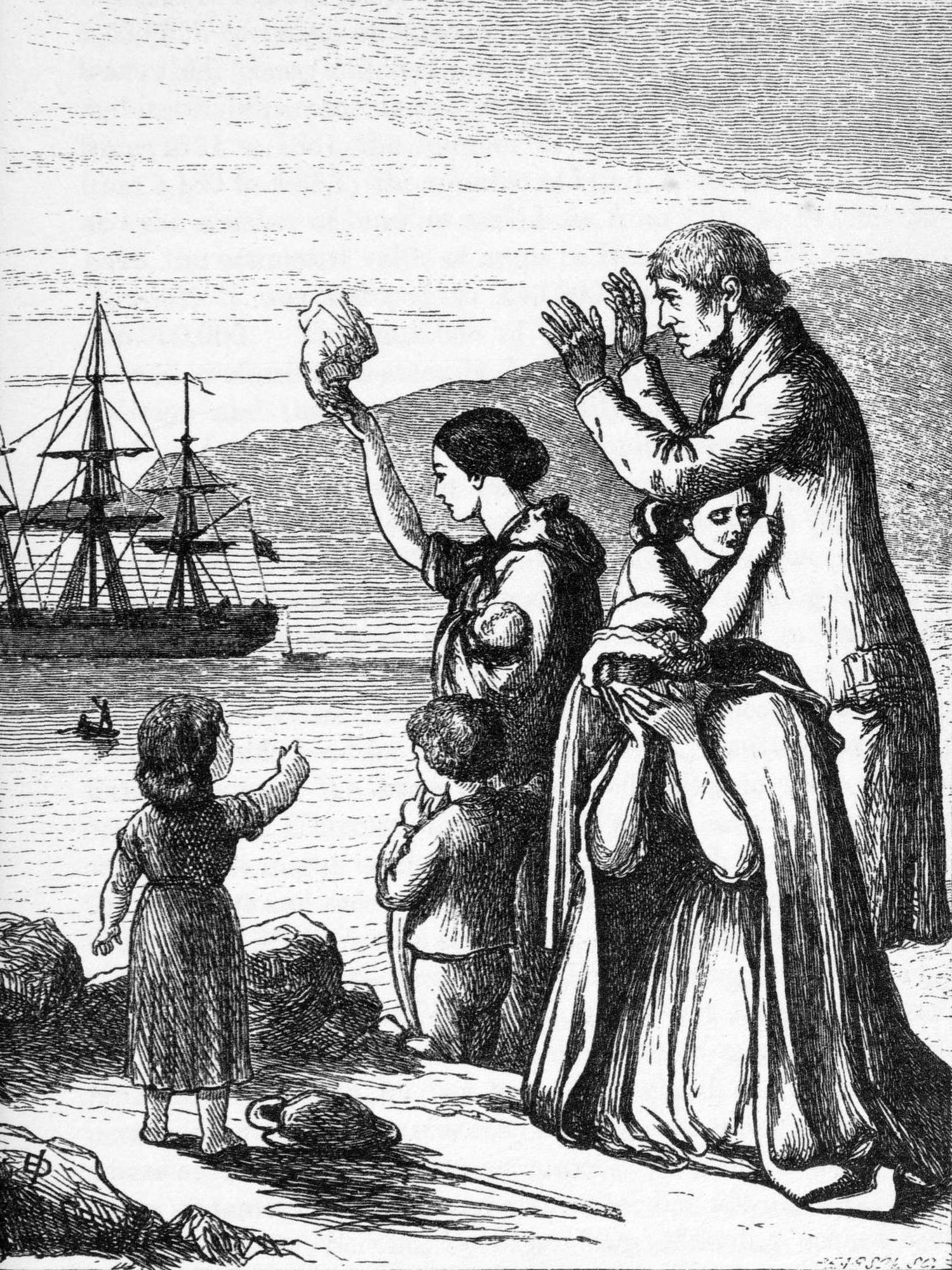 *Emigrants Leave Ireland* by Henry Doyle (1868). Though painted later, this scene captures the heartbreak of departure that thousands of Ulster families experienced.
The Decision to Leave
Five great waves of emigration brought over 200,000 people from Ulster to the American colonies between 1717 and 1775. 1717-1775 - Over 200,000 Ulster Scots emigrate to America The largest waves came in 1717-18, 1725-29, 1740-41, 1754-55, and 1771-75. Each was triggered by the same forces: crop failures, rising rents, religious discrimination. Each left Ulster a little emptier.
From 1755 to 1770 alone, 194 vessels were advertised to leave the North of Ireland ports for America. 1755-1770 - The Seven Years’ War reshapes global empires; Mozart is born Peak years were 1755 and 1767. Over 90% sailed to Philadelphia or New York. Each vessel averaged nearly 140 passengers plus freight.
In the 1760s, over 20,000 emigrants left from just five Ulster ports. Some sources say that figure is far too low. In peak years, as many as 6,000 people per year were leaving Ulster for America.
What drove them? Letters like this one, from Robert Parke, an Irish Quaker who had emigrated in 1724. He wrote to his relatives back in Ireland:
There is not one of the family but what likes the country very well…There is not one of the family but what likes the country very well and wod If we were in Ireland again come here Directly it being the best country for working folk & tradesmen of any in the world, but for Drunkards and Idlers, they cannot live well any where.
We have not had a days Sickness in the family Since we Came in to the Country, Blessed be god for it. My father has not had his health better these ten years than since he Came here.
Land is of all Prices Even from ten Pounds to one hundred Pounds a hundred, according to the goodness or else situation thereof, & grows dearer every year by Reason of Vast Quantities of People that Come here yearly from Several Parts of the world.
“Make what Speed you can to Come here,” Parke urged. “The Sooner the better.”
Letters like this circulated through Ulster. Ship agents hawked the benefits of America in every market town. Newspaper advertisements extolled the “goodness” of Philadelphia, the availability of land, the freedom from landlords. For families who had watched their rents double while their crops failed, for Presbyterians who faced discrimination from the Anglican establishment, for anyone who felt trapped in a province that seemed to offer only decline-America beckoned. The McGinnis family had once been lords in County Down. By the 1700s, they were likely tenant farmers like everyone else. The old Gaelic order was gone. America offered something Ulster no longer could: a chance to own land again.
Boarding the Ship
The emigrant trade was a business. Ships that carried flaxseed from America to Ireland-linen being Ulster’s main industry-needed cargo for the return voyage. Passengers fit the bill. At 140 emigrants per ship, the crossing was profitable in both directions.
From 1733 to 1750, Philadelphia received between 30,000 and 40,000 people from Ulster ports alone. 1733-1750 - Bach composes the Mass in B Minor; Benjamin Franklin experiments with electricity Governor Arthur Dobbs of North Carolina noted that as many as 10,000 immigrants from Holland, Britain, and Ireland landed at Philadelphia in a single season.
The emigrants who boarded these ships were a distinct people-not simply Scottish, not simply Irish. They were the Scots-Irish: descendants of the Lowland Scots who had settled in Ulster a century before, now mixed with Old Irish families who had adopted Presbyterian ways. The McGinnis name is Old Irish-the Magennis lords had been Catholic until the English conquest. But by the time our ancestor boarded a ship for Philadelphia, the family was Presbyterian. Somewhere in the generations between the Flight of the Earls and the crossing to America, the faith had changed. They brought with them a fierce independence, a Presbyterian faith that valued education and personal conscience, a clannish loyalty to family, and a willingness to push into frontier lands that more established colonists avoided.
If they could pay their passage, they came as free emigrants. If they couldn’t, they came as “redemptioners”-agreeing to be sold into years of indentured servitude upon arrival in exchange for the cost of their voyage. Some were shipped by the courts, clearing overcrowded prisons. Our McGinnis ancestors were likely among the “paid”-they traveled freely when they arrived and eventually bought land in North Carolina. This suggests they had enough resources to pay their own way.
However they paid, they all faced the same crossing.
The Atlantic
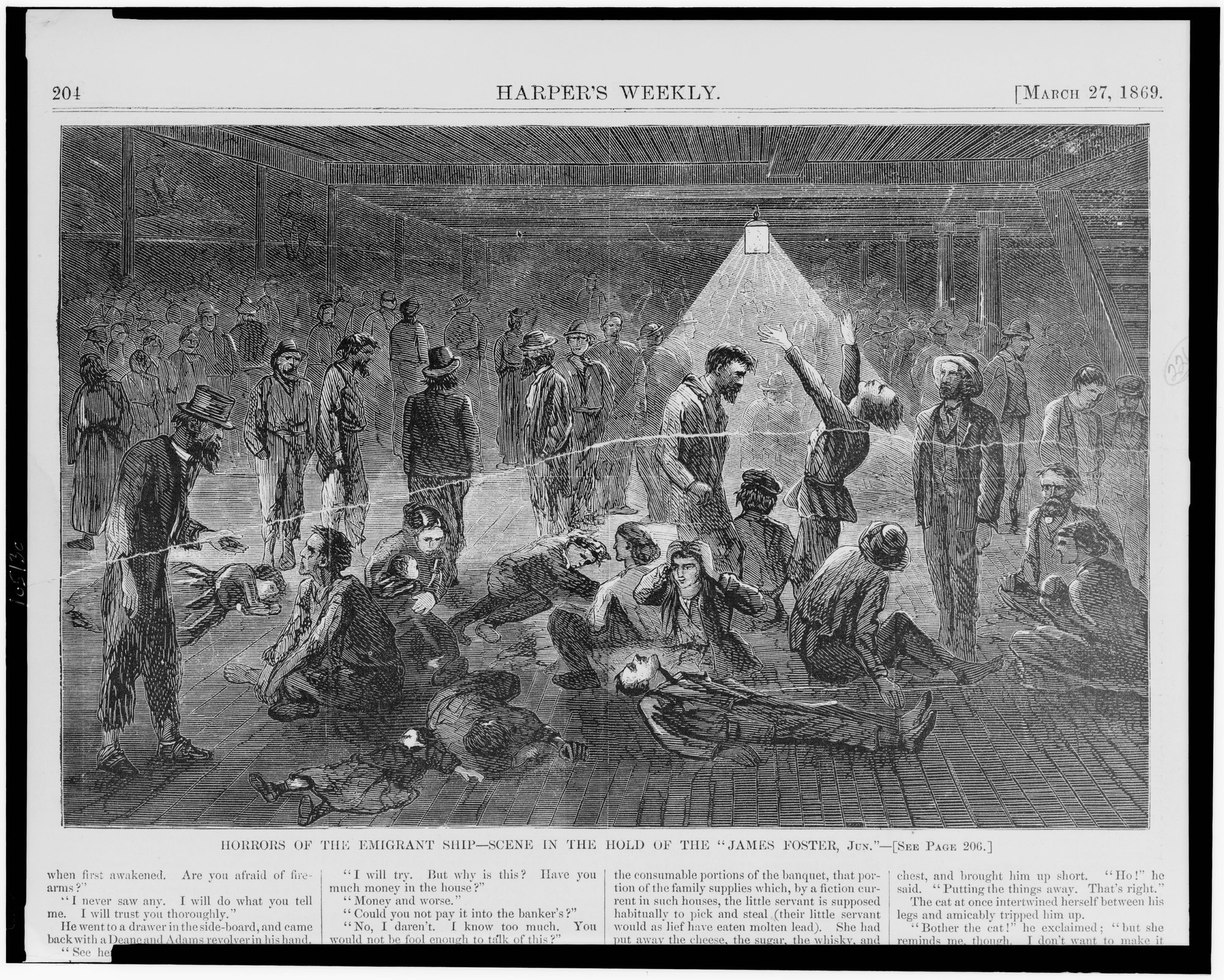 *Horrors of the Emigrant Ship* (1869). This illustration of the James Foster Jr. shows conditions similar to what 18th-century passengers endured.
We know what the voyage was like because Gottlieb Mittelberger, a German schoolmaster, traveled to Philadelphia in 1750 and wrote an unflinching account. Though he sailed from Rotterdam rather than Belfast, the conditions were the same for all emigrants packed into steerage:
In Rotterdam and in Amsterdam the people are packed densely, like herrings so to say, in the large sea-vessels.
The voyage typically lasted seven to twelve weeks. Seven to twelve weeks in a wooden hull, below deck, with 140 other passengers. No privacy. No fresh air. No escape.
Terrible misery, stench, fumes, horror, vomiting…Terrible misery, stench, fumes, horror, vomiting, many kinds of sea-sickness, fever, dysentery, headache, heat, constipation, boils, scurvy, cancer, mouth-rot, and the like, all of which come from old and sharply salted food and meat, also from very bad and foul water.
The drinking water was “very black, thick and full of worms.” The lice “abound so frightfully, especially on sick people, that they can be scraped off the body.” During storms, passengers could “neither walk, nor sit, nor lie” as the ship tossed violently, throwing bodies against the wooden walls.
Children suffered most:
Children from 1 to 7 years rarely survive the voyage… I witnessed 32 children in our ship, all of whom were thrown into the sea.
Thirty-two children. Wrapped in canvas, weighted with ballast, slipped over the side into the grey Atlantic. Their parents watching. Then turning back to the cramped darkness below deck, trying to keep their remaining children alive for another day, another week, until land appeared.
The Seaflower
The worst recorded disaster occurred in 1741. 1741 - Handel’s Messiah premieres in Dublin The Seaflower left Belfast with 108 passengers bound for Philadelphia. Sixteen weeks later-twice the normal voyage time-HMS Success discovered the ship drifting without direction. The master and all crew but one had died, leaving the passengers adrift with no provisions and no one who knew how to sail.
Only 65 passengers remained alive.
The Pennsylvania Gazette of November 12, 1741 reported what the rescuers found:
The Body of a Man lying upon Deck partly cut up…His Majesty’s Ship Success discovered the Seaflower… the Body of a Man lying upon Deck partly cut up, and his Arm… Survivors had concealed Pieces of it in their Pockets, to eat as they had Opportunity.
The survivors had eaten six people who died during the passage. They were preparing a seventh when rescued. Salt water had been their only drink for weeks.
The Seaflower was the worst case. But every crossing was a gamble with death. Disease could sweep through a ship in days. Storms could drive vessels off course for weeks. Provisions could run low. And there was no rescue coming-only the horizon, day after day, until finally, if you were lucky, land appeared.
Such was the price of freedom. What the Ulster families ran from was so desperate, so hopeless, that they forced themselves to endure even this to reach America. Somewhere on one of these ships, in one of these crossings, a McGinnis family endured this passage. We don’t know which ship. We don’t know which year. But we know they survived-because their descendants are still here.
Philadelphia
After weeks at sea, the survivors finally saw the Delaware River widen into the port of Philadelphia. They had made it. They were alive.
But arrival brought its own trials.
The ill and weak passengers faced a town that could hardly absorb their needs. Thousands of emigrants poured in every season, many of them sick, all of them desperate. The docks were chaos-ship agents, merchants, con men, all looking to profit from the newcomers.
For the redemptioners-those who couldn’t pay their passage upfront-arrival meant another ordeal:
The sale of human beings in the market on board the ship…The sale of human beings in the market on board the ship is carried on thus: Every day Englishmen, Dutchmen and High-German people come from the city of Philadelphia… Adult persons bind themselves in writing to serve 3, 4, 5 or 6 years for the amount due by them… Many parents must sell and trade away their children like so many head of cattle.
Parents selling their children to pay for the voyage that was supposed to give those children a better life. Such was the reality of eighteenth-century immigration.
For those who had paid their own way, the priority was simple: get out of the city as fast as possible. Philadelphia was crowded, expensive, and the land nearby was already claimed. Many emigrants were taken advantage of by “less than honorable people” who stole their last coins. Getting on the road was paramount.
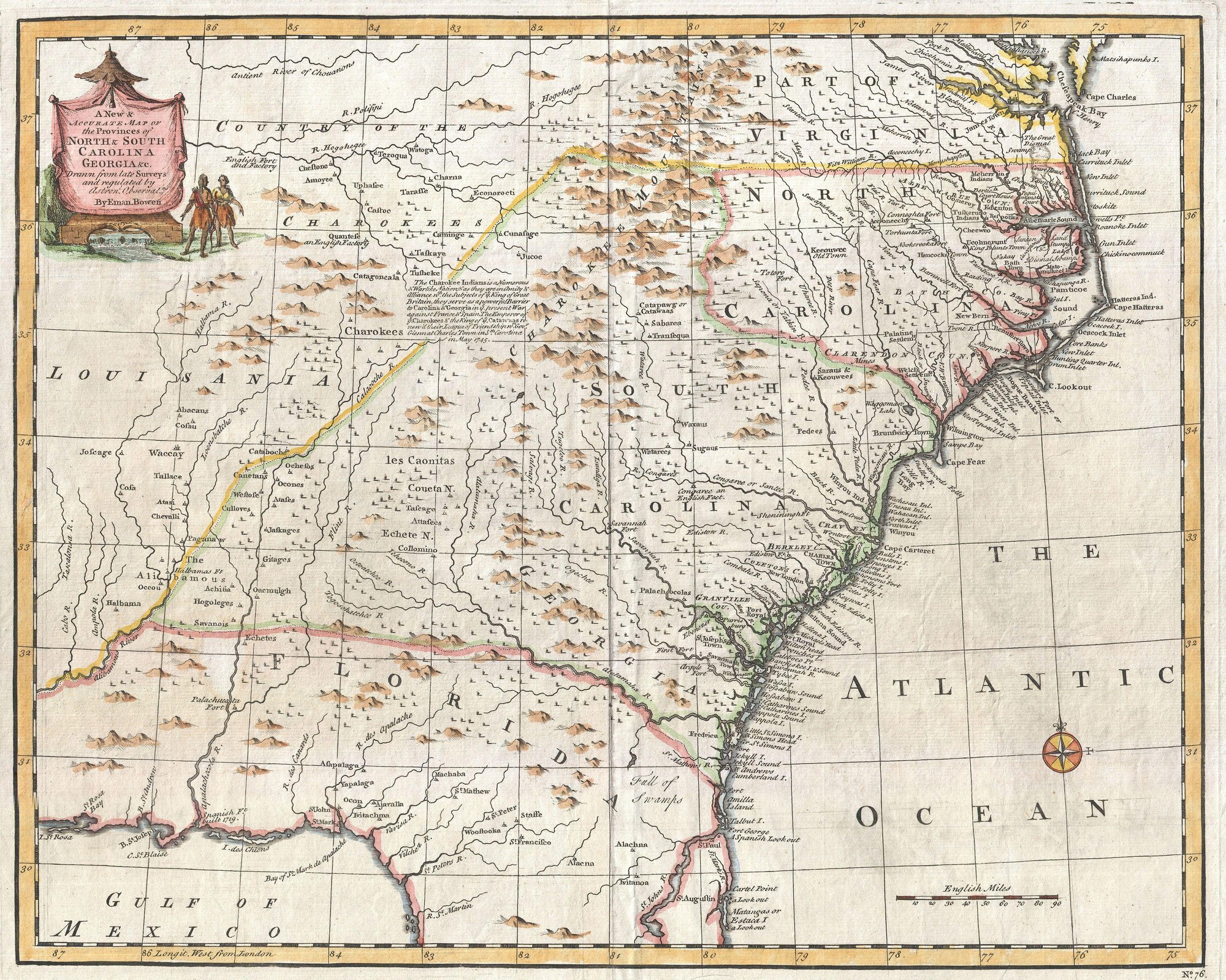 Emanuel Bowen's 1747 map of Carolina and Georgia shows the colonial landscape the McGinnis family would have traversed heading south from Philadelphia.
But the road to where? Governor Dobbs noted that emigrants were “obliged to remove to the southward for want of lands to take up” in Pennsylvania. The coastal lands were claimed. The good farmland was owned. As late arrivals, the Scots-Irish had to push into the frontier-the backcountry of Pennsylvania, the valleys of Virginia, the Piedmont of the Carolinas.
And so they headed south, following an old Indian trail that would become known as the Great Wagon Road. This is where we pick up the McGinnis trail. We can’t trace them on a specific ship or to a specific arrival date. But we know where they ended up: in the records of a Presbyterian church in North Carolina, among a community of fellow Ulster emigrants. The path from Philadelphia to Carolina was well-worn by the 1750s. Our ancestors walked it too.
The Presbyterian Trail
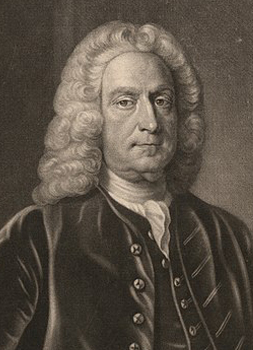 Governor Arthur Dobbs (1689-1765), who encouraged Scots-Irish settlement in North Carolina's backcountry.
Governor Arthur Dobbs of North Carolina understood exactly who these new settlers were. Writing in 1755, he described them plainly:
They are a colony from Ireland, removed from Pennsylvania, of what we call Scotch-Irish Presbyterians, who with others in the neighboring Tracts had settled together in order to have a teacher of their own opinion and choice.
“Scotch-Irish Presbyterians.” This was the label that would follow these Ulster emigrants through American history. And it was their faith-their stubborn, independent, congregation-governing Presbyterian faith-that would leave the clearest trail for us to follow.
In 1758, Rev. Alexander Craighead arrived in Mecklenburg County, North Carolina to serve congregations between the Yadkin and Catawba Rivers. 1758 - The French and Indian War rages; British capture Fort Duquesne Craighead was a firebrand-born in Donegal, Ulster, he refused to take the oath of allegiance to the British government. He and possibly his father were credited with gathering up folks in Ireland and leading groups from Ulster to America and down to North Carolina. He is counted as the spiritual father of the Mecklenburg Declaration of Independence, framed nine years after his death by the very congregations he had led.
Rocky River Presbyterian Church, organized about 1751 when the area was still part of Mecklenburg County, is the oldest Presbyterian church in what is now Cabarrus County. 1751 - The first volume of Diderot’s Encyclopédie is published Its “Early Membership Rolls” prior to 1835 include a “List of Patriots and Soldiers of the Revolutionary Period.”
On that list: “Charles McGinnis, Colonel, PA.“ This is him. “Old Charles”-the patriarch of our traceable line. Listed as a Revolutionary War patriot in a Presbyterian church founded by Ulster emigrants, in a county settled almost entirely by Scots-Irish families. An Old Irish name. A Presbyterian faith. An American future.
We are confident this is the same Charles McGinnis listed in “Mecklenburg County Abstract and Land Entries” in 1789. 1789 - The French Revolution begins; Washington inaugurated as first President He also appears in the 1790 census for Mecklenburg County. 1790 - The first U.S. Census counts nearly 4 million Americans The Revolutionary War service indicated on the church entry is not yet confirmed. But the faith is. The place is. The name is.
We all descend from this early pioneer.
Even today, you can visit Cabarrus County and the city of Concord and find a disproportionate number of Presbyterian churches compared to Baptist churches-unusual for the South, where Baptists typically dominate. 1734 - The Great Awakening sweeps the colonies This goes back to the vast number of Scots-Irish who settled here in the 1700s. The faith they carried across the Atlantic still shapes the landscape.
Elsewhere in 1734: The Salzburgers Cross
The McGinnises were not the only refugees crossing the Atlantic in these years. Another group of exiles was making the same desperate gamble-and their story would eventually intertwine with ours, though no one could have known it at the time.
In 1731, the Prince-Archbishop of Salzburg-a Catholic principality in what is now Austria-issued an edict of expulsion on October 31, Reformation Day. All Protestants must recant their Lutheran faith or leave. Over 20,000 chose exile over betrayal. They were given as little as eight days to depart, and in a cruel stipulation, parents were initially told they must leave behind any children under twelve to be raised as Catholics.
Contemporary accounts describe tearful columns of exiles trudging through mountain snow, singing hymns to keep their courage. They sang the “Exulantenlied”-the Hymn of the Exiles-whose verses gave them comfort as they “wandered foreign roads” for the sake of God’s Word. One exile later wrote that they departed “with tears in our eyes, yet joy in our hearts, knowing that God would not forsake us.”
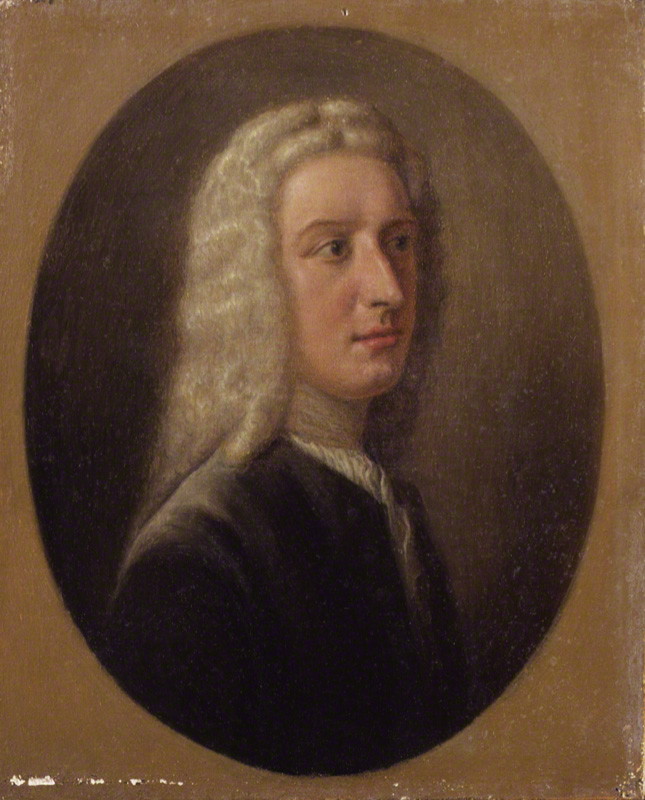 General James Edward Oglethorpe (1696-1785), founder of Georgia and champion of the Salzburger refugees.
Most Salzburgers accepted an invitation from the King of Prussia to settle depopulated lands in East Prussia. But about 300 humble farmers and miners from alpine valleys volunteered for something far more daring. The Trustees of the newly founded colony of Georgia, led by General James Oglethorpe, had heard of their plight and offered free passage to America, land and tools, provisions for a year, and the freedom to practice their religion openly.
For people who had lost everything but their faith, it was an answer to prayer.
In January 1734, the first group of Salzburgers boarded the merchant ship Purysburg bound for the New World under the spiritual leadership of two young Lutheran pastors, Johann Martin Boltzius and Israel Christian Gronau. Boltzius kept a detailed diary and later described their journey with characteristic piety:
Into danger, but closer to God.
As England’s coast disappeared behind them, one of their leaders recorded that “a universal joy appeared amongst the Salzburgers, who praised God that He had heard their prayers.” They viewed the favorable winds carrying them west as a sign of divine deliverance.
The Atlantic crossing was long and perilous. The emigrants endured close quarters, rough seas, and even a frightening fire alarm onboard. “No ill accident ensued,” one passenger wrote thankfully, but the scare reminded them of “the uncertainty of this life, and the eternity of the next.”
After two months at sea, they arrived in Savannah on March 12, 1734. 1734 - Georgia is barely a year old; Savannah has fewer than 500 residents The townspeople fired cannons in salute and cried “Huzzah!” in celebration. A good dinner was prepared, and even English strong beer was provided to refresh their spirits. “The inhabitants showed them a great deal of kindness,” one diary noted, and seeing the fertile country, “they were full of joy and praised God for it.”
Within days, Oglethorpe led them about 25 miles upriver from Savannah to their new home site. There, amid Georgia’s pine forests and swamps, they founded a town they named Ebenezer-Hebrew for “stone of help”-to signify their conviction that God had helped them come this far. Upon reaching the spot, the group “erected a monument of stones” in thanksgiving.
The first years were brutal. The original site proved low-lying and marshy, breeding disease. Within two years, approximately thirty settlers died of dysentery. Crops failed in the poor soil. One contemporary noted that “the hottest dog-days in Germany could hardly compare” with the steamy heat of a Georgia summer. The dense virgin forests were filled with towering trees difficult to clear, and it was easy to get lost-one young man who wandered off was lost forever in the trackless forest.
By 1736, the survivors-their number down to about 200-petitioned Oglethorpe to relocate. He agreed. They moved ten miles to a high bluff overlooking the Savannah River, called the new site “New Ebenezer,” and started again.
Two refugee families. Two crossings. Two stories beginning in parallel-the Scots-Irish Presbyterians heading for Philadelphia, the German Lutherans building their Ebenezer near Savannah. They knew nothing of each other. Their paths would not cross for more than two centuries.
But they would.
Chapter Navigation
← Previous: The Old Country | Guide Home
References
McGinnis, Richard W. (2003). 1700-2003 My McGinnis History Begins to Fit: An old Irish family from Ulster comes to North Carolina and then to Georgia. Compiled with assistance from Sharon Tate Moody, CGRS.
Dickson, R.J. (1988). Ulster Emigration to Colonial America 1718-1775. Ulster Historical Foundation. The first balanced and professional study of the entire Ulster emigration phenomenon.
“British Immigration to Philadelphia: The Reconstruction of Ship Passenger Lists from May 1772 to October 1773.” Pennsylvania History: A Journal of Mid-Atlantic Studies. Academic study utilizing newspaper records and indenture contracts to reconstruct passenger lists.
Historical Society of Pennsylvania. Alphabetical Index to Ulster Emigration to Philadelphia (Ref F158.25 .A3 1996). Comprehensive index of Ulster emigrants to Philadelphia.
Coldham, Peter Wilson (1988). The Complete Book of Emigrants in Bondage, 1614-1775. Genealogical Publishing Co. Contains records of indentured servants and transported individuals.
Custom House (London, England) Redemptioner’s Registry, February 7, 1774 to July 29, 1775. Contains entries for name, age, occupation, former residence, port-bound, ship or vessel, master’s name, and reason for leaving the country.
Mittelberger, Gottlieb. Journey to Pennsylvania in the Year 1750 and Return to Germany in the Year 1754. Published 1756. The most detailed firsthand account of 18th-century emigrant ship conditions. Available at https://historymatters.gmu.edu/d/5713 and Library of Congress https://www.loc.gov/item/01010742/
“A ‘Cannibal Cruise Liner’ of 18th-century Immigration.” Historical Society of Pennsylvania, https://hsp.org/blogs/hidden-histories/a-cannibal-cruise-liner-of-18th-century-immigration. Details the Seaflower disaster of 1741 based on Pennsylvania Gazette accounts.
Parke, Robert. Letter from Chester County, Pennsylvania, 1725. In National Humanities Center: Two Irish Settlers in America, 1720s-1740s, https://nationalhumanitiescenter.org/pds/becomingamer/growth/text4/irishpennsylvania.pdf
“Craighead, Alexander.” NCpedia, https://www.ncpedia.org/biography/craighead-alexander. Biography of the Presbyterian minister who led settlers from Ulster to North Carolina.
“Dobbs, Arthur.” NCpedia, https://www.ncpedia.org/biography/dobbs-arthur. Governor of North Carolina 1754-1765, who encouraged Scots-Irish settlement.
“Rocky River Presbyterian Church.” UNC Charlotte Research Guides, https://guides.library.charlotte.edu/c.php?g=1271129&p=9355033. History of one of the oldest Presbyterian churches in the Carolina Piedmont, organized 1751.
“Scottish Settlers.” NCpedia, https://www.ncpedia.org/scottish-settlers. The Scots-Irish were descendants of the Lowland Scots whom James I of England had settled in Ulster, the northern province of Ireland, and became the largest ethnic group among settlers in the Carolina backcountry.
“Scots Irish (Scotch Irish).” Encyclopedia of Greater Philadelphia, https://philadelphiaencyclopedia.org/essays/scots-irish/. Philadelphia was the primary port of entry for Scots-Irish immigrants, who then moved into the Pennsylvania backcountry and down the Great Wagon Road.
Barlament, James. “Salzburgers.” New Georgia Encyclopedia, updated Oct 19, 2016.
“The ‘Salzburgers’ in Ebenezer, Georgia, 1734.” Austrian Press & Information Service (2018).
Von Reck, P.G.F., and Rev. J.M. Boltzius. Journals (excerpts), March 1734. In National Humanities Center: Becoming American.
Jones, George Fenwick. The Salzburger Saga: Religious Exiles and Other Germans Along the Savannah. Athens: UGA Press, 1984.
Urlsperger, Samuel, ed. Detailed Reports on the Salzburger Emigrants Who Settled in America (1733-1741). Translated by Geo. Fenwick Jones et al. Athens: UGA Press, 1968-85.
Emigrants Leave Ireland by Henry Doyle (1868). From Illustrated History of Ireland by Mary Frances Cusack. Wikimedia Commons, public domain.
Horrors of the Emigrant Ship (1869). Harper’s Weekly illustration of the brig James Foster Jr. Wikimedia Commons, public domain.
Governor Arthur Dobbs portrait. Colonial Williamsburg Foundation. Wikimedia Commons, public domain.
Emanuel Bowen, “A New and Accurate Map of the Provinces of North & South Carolina, Georgia &c.” (1747). Wikimedia Commons, public domain.
Portrait of James Edward Oglethorpe by Alfred Edmund Dyer, after Francis Hayman. National Portrait Gallery, London. Wikimedia Commons, public domain.
Plan of New Ebenezer (1742). Georgia Historical Society. Wikimedia Commons, public domain.
Jerusalem Lutheran Church, Ebenezer, Georgia. Photo by Michael Rivera (2015). Wikimedia Commons, CC BY-SA 4.0.