Chapter 3: The Great Wagon Road
Charles McGinnis-“Old Charles,” as we’ll call him to distinguish him from the many Charleses who would follow-was probably born about 1752, possibly in Pennsylvania. 1752 - Benjamin Franklin’s kite experiment with electricity He is the patriarch of our line, the man from whom we all descend. Yet like so many who came before the age of careful record-keeping, much of his life remains in shadow.
What we know is this: the early membership rolls of Rocky River Presbyterian Church in North Carolina list him as “Charles McGinnis, Colonel, PA.” That designation-“PA”-tells us he came from Pennsylvania. And if he came from Pennsylvania to the Carolina backcountry in the mid-to-late 1700s, there was only one way to travel: the Great Wagon Road.
The Road South
Long before European settlers arrived, indigenous peoples had established a network of trails running through the great valley between the Appalachian Mountains and the eastern seaboard. The Catawba, Cherokee, and Iroquois Confederacy used these paths for trade, diplomacy, and war. The Iroquois called the main north-south route the Great Warrior Path, traveling it during their campaigns against the Catawba and Cherokee nations to the south. ~1540 - Hernando de Soto becomes first European to travel these trails
William Byrd II, surveying the Virginia-Carolina boundary in 1728, described the indigenous trade network that had flourished for centuries:
The Trading Path above mentioned receives its name from being the Route the Traders take with their caravans, when they go to traffick with the Catawbas and other Southern Indians… The Course from Roanoke to the Catawbas is laid down nearest Southwest, and lies through a fine country, that is watered by Several beautiful Rivers.
The Catawba Nation-who called themselves Ye Iswąˀ, “people of the river”-had lived along the Catawba River for at least 6,000 years before European contact. The Catawba remain today as a federally recognized nation, the only one in South Carolina. Their ancestors’ trading paths became the roads that carried Charles McGinnis south. Their villages were major hubs in a trade system connecting Virginia traders with nations throughout the Piedmont. Further north along the trail, the Occaneechi acted as middlemen, their language serving as a lingua franca among the diverse Siouan-speaking peoples of the region: the Saponi, Tutelo, Eno, and others.
But European contact had already devastated these nations. John Lawson, who traveled 500 miles through the Carolina Piedmont in 1701, witnessed the aftermath:
The Small-Pox and Rum have made such a Destruction amongst them, that, on good grounds, I do believe, there is not the sixth Savage living within two hundred Miles of all our Settlements, as there were fifty Years ago.
In 1744, at the Treaty of Lancaster, colonial authorities acquired travel rights to the Great Warrior Path. 1744 - King George’s War begins between Britain and France Within a generation, what had been an indigenous trade network became the most heavily traveled road in colonial America. The colonists called it the Great Valley Road, the path of large migrations into the Virginia and Carolina backcountry. The Scots-Irish settlers who poured down this road were moving into a landscape that had been emptied by disease and dispossession.
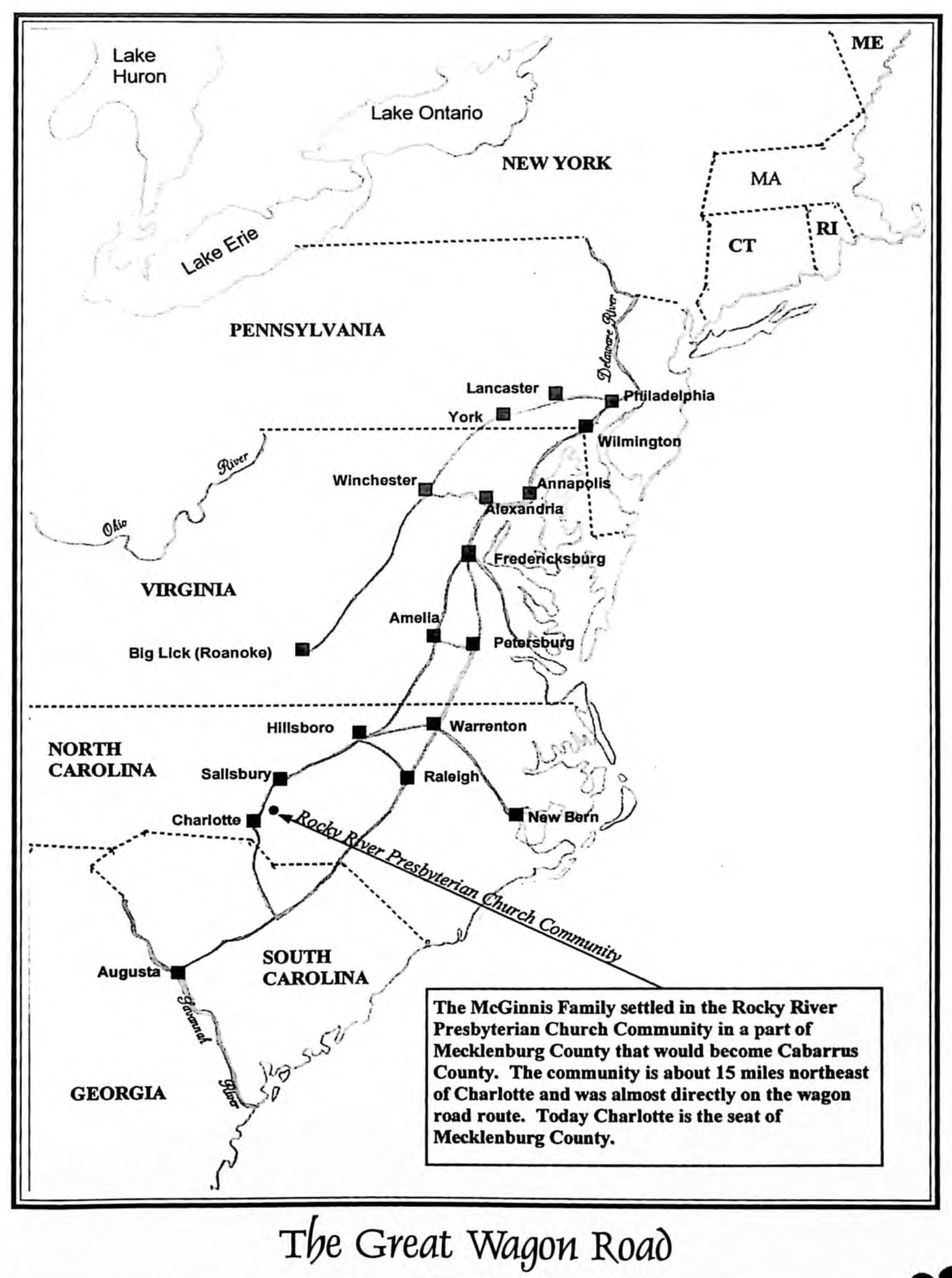 The Great Wagon Road stretched 700 miles from Philadelphia to Georgia, the most heavily traveled route in colonial America.
From Philadelphia to Georgia, this 700-mile backcountry road was the most used of all roads funneling emigrants away from port cities to lands west and south. Tens of thousands of Scots, Irish, and Germans crowded onto the road in the mid-1700s. Bishop Spangenberg of the Moravian church, who traveled the road in 1752 to survey land for his congregation, recorded the scale of this migration:
After having traversed the length and breadth of North Carolina we have ascertained that towards the Western mountains, there are plenty of people who have come from Virginia, Maryland, Pennsylvania, New Jersey and even from New England. Even in this year more than 400 families with horses, wagons, and cattle have migrated to this State, and among them are good farmers and very worthy people who will no doubt be of great advantage to the State.
A connection from the Pennsylvania communities of Lancaster, York, and Gettysburg gave settlers access to the Great Valley Road. This link became known as the Philadelphia Wagon Road. Most who traveled it were middle-class farmers or craftsmen. They were also Presbyterians.
The Journey
Moving westward and then to the south, travelers encountered the huge task of crossing the Potomac River and even bigger rivers as they continued southward. The Appalachian Mountains to the west were a barrier that turned the wagons south in the valleys.
Backcountry flooding was a real problem for the wagons moving south. In good weather, a single horseman could ride from Philadelphia to a home in North Carolina in just under eight days. Moving 50 miles a day was a good day, with 30 miles more the norm. A report says the average load per wagon was 2,000 pounds; two to four horses pulled most wagons. The famous Conestoga wagon with canvas top was most popular. The poorest of people walked. Moravians often walked the 400 miles from Bethlehem, PA to Wachovia, NC. Walkers made the trip in 30-41 days.
Wagons were slowed by river crossings that were very hazardous for man and beasts pulling heavy wagons. Ferries sprang up crossing rivers, including the Yadkin River in North Carolina. The ferry rate was eight pence per wheel.
In 1765, the volume of fall and winter traffic moving down to Salisbury, NC was more than 1,000 wagons. 1765 - The Stamp Act ignites colonial protest Salisbury had long been a trading center where the Great Trading Path-the main route to the Catawba villages-intersected with trails running east to the coast.
The Scots-Irish using the Great Wagon Road made some 30 miles a day without rain and often settled in camp stops along the road to heal, rest, and start a family. Many moved more than once before ending their journey.
When the first Moravian settlers arrived at their tract in North Carolina after six weeks on the road from Pennsylvania, their diarist recorded the moment they reached the wilderness that would become their new home:
While we held our lovefeast, the wolves howled loudly, but all was well with us and our hearts were full of Thanksgiving to the Savior who had so graciously guided us and led us.
This was the world Charles McGinnis entered-a frontier where wolves still howled at night and every family had to carve their own place from the wilderness.
The Character of the Scots-Irish
The Scots-Irish were reputed to be a clannish group, set in their ways, not easy to sway one way or another. It is said that the Scots-Irish coming south had a prayer: “Lord grant that I may always be right, for thou knowst I am hard to turn.”
Also a thrifty people, the Scots-Irish were referred to as “keepers of the commandments of God and everything else they could get their hands on.”
Not everyone admired them. Charles Woodmason, an Anglican minister who traveled through the Carolina backcountry in the 1760s, encountered the Scots-Irish Presbyterians frequently-and they made their feelings about his church abundantly clear:
These debauch’d licentious fellows… Scots Presbyterians who had hir’d these lawless Ruffians to insult me… informed me that they wanted no Damn’d Black Gown Sons of Bitches among them.
Woodmason was no neutral observer-he was an Anglican gentleman who looked down on these frontier dissenters. But his account captures something true about the Scots-Irish character: they were fiercely independent, deeply Presbyterian, and absolutely unwilling to be pushed around by anyone claiming authority over them.
Charles McGinnis was one of them.
Meanwhile in Georgia: The Salzburgers Thrive
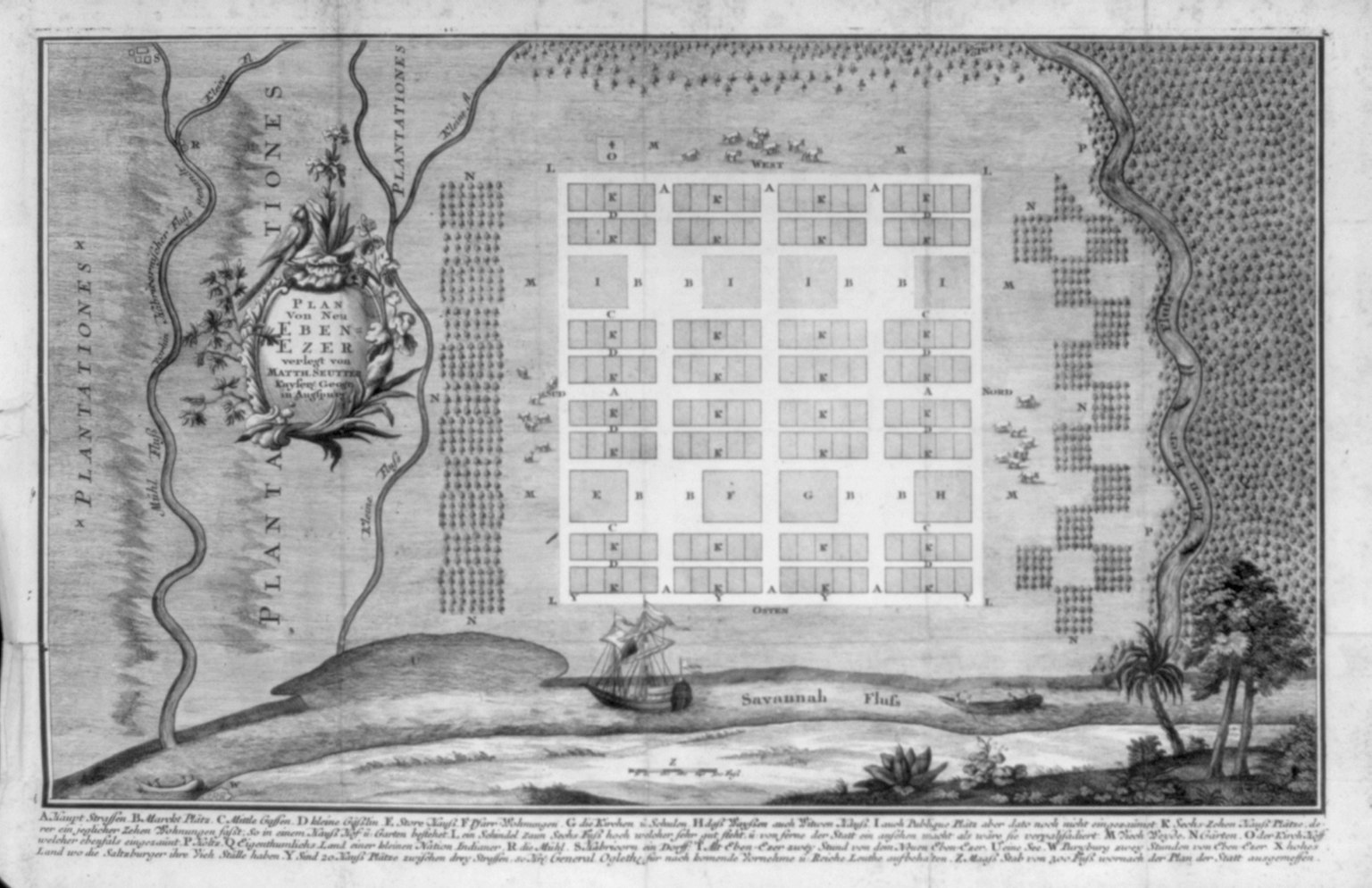 Plan of the Salzburger settlement at New Ebenezer, Georgia (1742), showing the orderly layout of the relocated community.
While the Scots-Irish were pouring down the Great Wagon Road, another group of Protestant refugees was building something remarkable 500 miles to the south. Remember the Salzburgers from Chapter 2? The German Lutherans expelled from Austria who arrived in Georgia in 1734? By the time Charles McGinnis was traveling the Wagon Road, the Salzburgers had transformed their swampy settlement into a thriving community.
At New Ebenezer, the Salzburgers had moved past mere survival. In 1740, they built Georgia’s first water-powered grist mill, followed by sawmills and rice pounding mills. 1740 - Frederick the Great becomes King of Prussia They founded the colony’s first orphanage. They operated Georgia’s first silk-reeling house. Most notably, they firmly supported the colony’s ban on slavery-proving that European immigrants could prosper in Georgia without enslaved labor.
Two parallel stories: the Scots-Irish pushing into the Carolina backcountry, the German Lutherans building mills on the Savannah River. Both Protestant refugees. Both starting over in a new land. Both would eventually end up in the same state, in the same extended family-though neither could have imagined it then.
Mecklenburg County
About 1750, the little hamlet of Charlotteburgh was settled and became the seat for Mecklenburg County. ~1750 - Bach’s Art of Fugue composed In 1768, largely Scotch-Irish traders chartered it as a town. 1768 - Captain Cook begins his first voyage Later named Charlotte, it was a hotbed of Presbyterianism.
Augusta, Georgia eventually was the south terminal of the Great Wagon Road, but the earliest path ended in North Carolina where Mecklenburg County was formed in 1763. 1763 - Treaty of Paris ends the French and Indian War This was where the McGinnis clan was first recorded in history traceable directly to our generation.
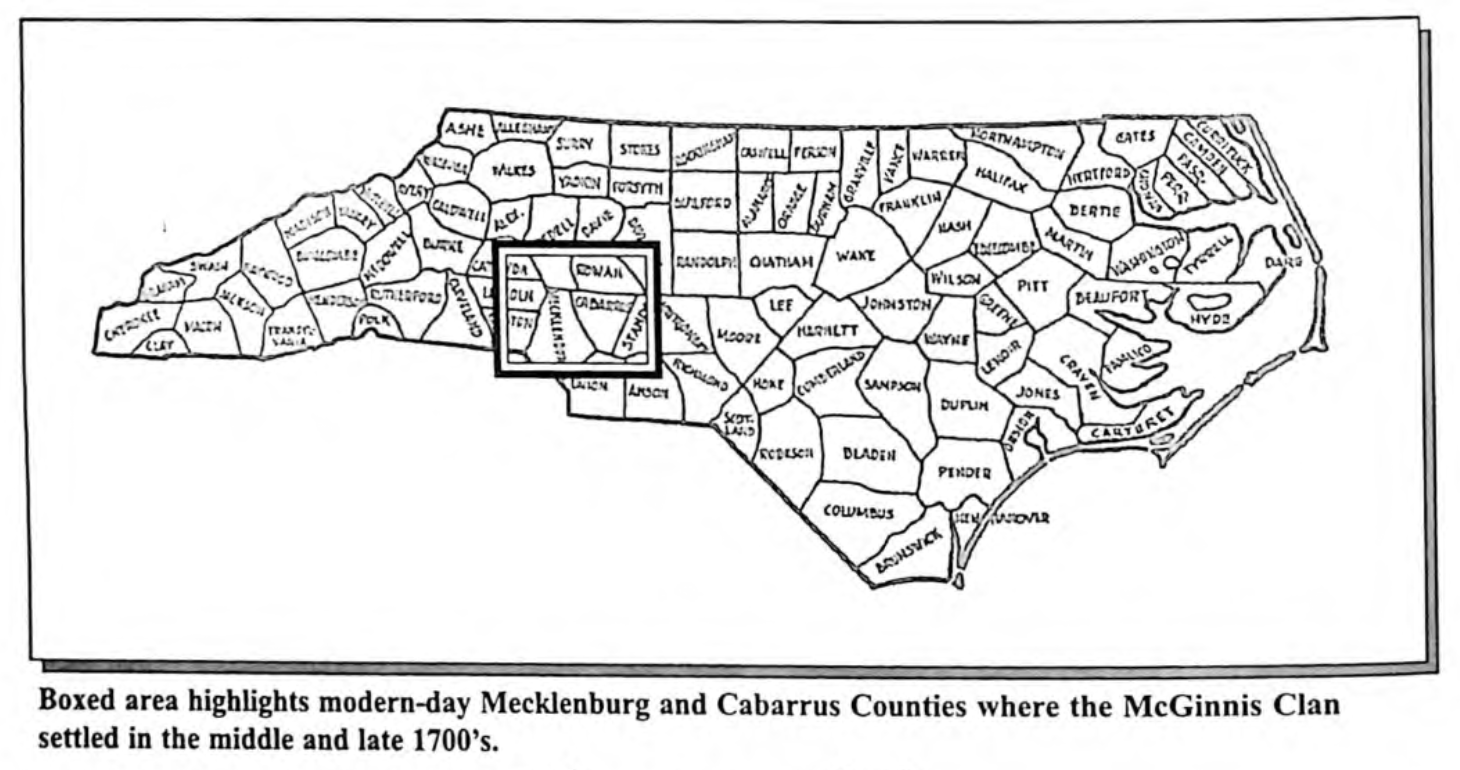 Mecklenburg County, North Carolina, where the McGinnis family first appears in American records.
Mecklenburg-a German word-was formed as a county from land that was part of Anson County. The Scots-Irish people were settled there with immigrants from several countries, but the largest mix was Irish and Germans. As is common, the lifestyle, the language, the mannerisms, and personality traits were generally in conflict with each other. Names were difficult to pronounce, much less spell. Some of the Irish were still using some Gaelic tongue, and even the English could not understand it.
These backcountry settlers had grievances-against corrupt local officials, against excessive taxes, against a colonial government that favored the wealthy planters of the eastern counties. In the late 1760s, these frustrations boiled over into the Regulator movement. 1769 - Napoleon Bonaparte is born in Corsica George Sims, speaking for the Regulators, made their position clear:
Well Gentlemen, it is not our Form or Mode of Government, nor yet the body of our Laws that we are quarrelling with, but with the Malpractices of the Officers of our County Court, and the Abuses that we suffer by those that are impowered to manage our public affairs.
The Regulators sought, in their own words, “to be Governed by Law, and not by the Will of officers.” The movement was crushed at the Battle of Alamance in 1771, but its spirit lived on. Within five years, these same backcountry settlers would be fighting for independence from Britain itself.
Charles in the Revolution
It is likely that Charles married about 1770, probably in Pennsylvania or Virginia, to a woman named Jennet whose surname is unknown. 1770 - Boston Massacre We know her only as Jennet McGinnis, a ghost in the records, a woman who crossed an ocean or was born to those who did, who raised children in the wilderness, who outlived her husband and left her name in his will.
The Great Wagon Road played a big part in the Revolutionary War. 1775-1783 - American Revolutionary War When the British captured Philadelphia, this road was an escape route for the Continental Congress, which fled down to York. Cornwallis later used it to get into the southern colonies, and it became the western front for the Revolutionary War.
The church records list Charles as “Colonel, PA”-suggesting military service in Pennsylvania. We have not yet confirmed his Revolutionary War service, but the designation is significant. If accurate, Charles fought for American independence before making his way south to Carolina.
At some point after the war, Charles and Jennet moved to North Carolina. They were there in Mecklenburg County by 1790 when Charles appeared in the census as head of his household of three females and two males-likely his wife and four children.
Building a Life in Cabarrus
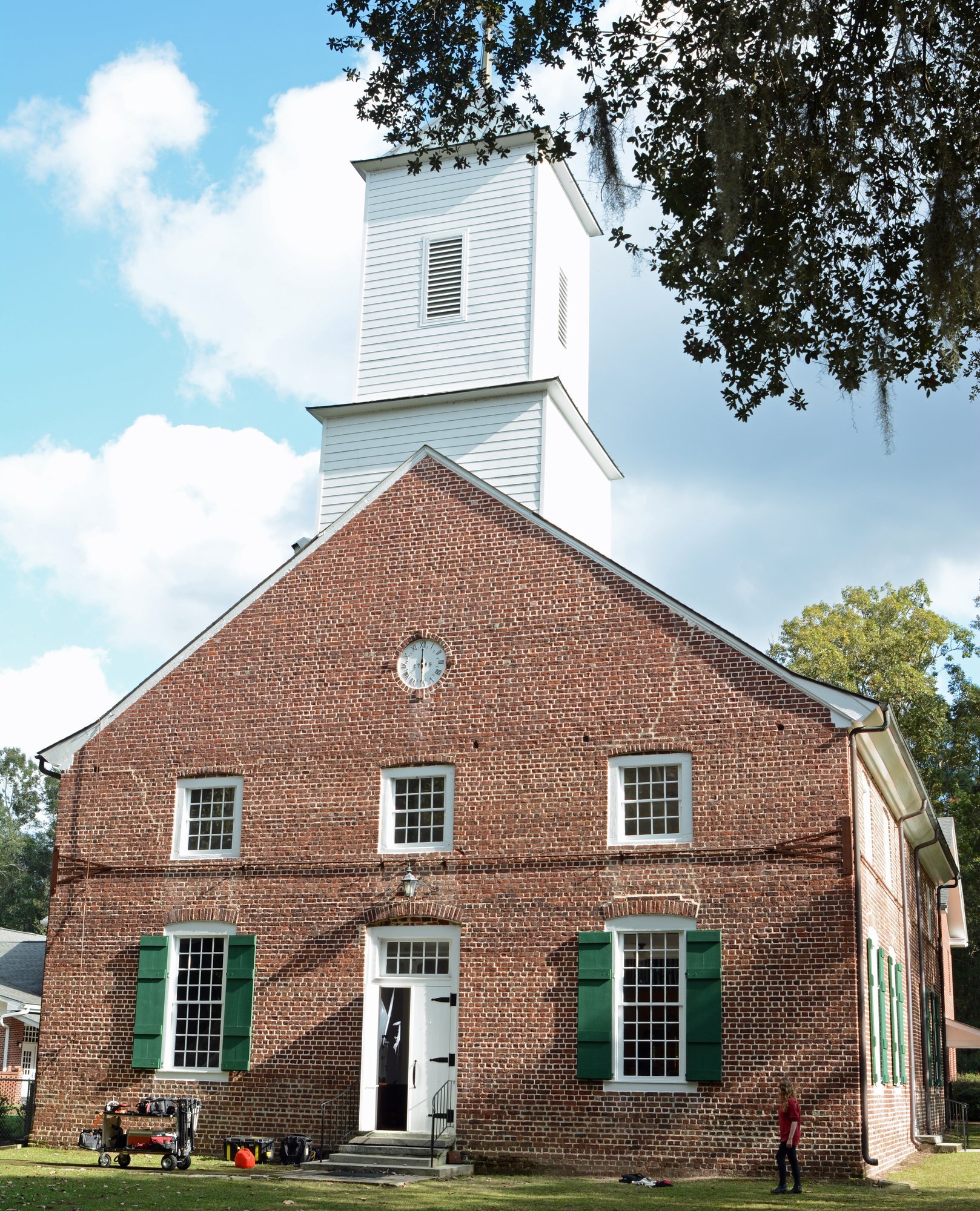 Jerusalem Lutheran Church (completed 1769), the oldest continuously worshipping Lutheran church in America, built by the Salzburger descendants.
In 1769, as Charles was likely still in Pennsylvania preparing to head south, the Salzburgers completed something that would endure: a beautiful brick church named Jerusalem Church. 1769 - Watt patents the steam engine Built with faith and brick by the descendants of exiles, it still stands today as the oldest continuously worshipping Lutheran church in America.
Both communities were building houses of worship in these years-the Scots-Irish their Presbyterian meeting houses in Mecklenburg, the Germans their Lutheran church on the Savannah. Both were putting down roots. Both were transforming from refugees into Americans.
Charles was shown in Mecklenburg, Salisbury District, in the 1790 census, and in 1800 he was in Cabarrus County. It is likely that he did not move from his 1790 location but that his location was a portion of Mecklenburg that went to form Cabarrus in 1792. 1792 - France becomes a republic; Louis XVI imprisoned
 The Rocky River area of Cabarrus County, where Charles McGinnis settled and worshipped.
McGinnis was in Cabarrus County in 1795 when he was high bidder for 28 acres of land in Mecklenburg County on both sides of the Huggensen Branch on the south side of Reedy Creek. He was identified as being “of Cabarrus County.” He paid 20 shillings for the land.
By the 1800 census in Cabarrus County, only one son remained in Charles’s household. He also claimed one slave. The Charles McGinnis who died in 1816 bequeathed one slave in his will-evidence that this is the same man.
The Will
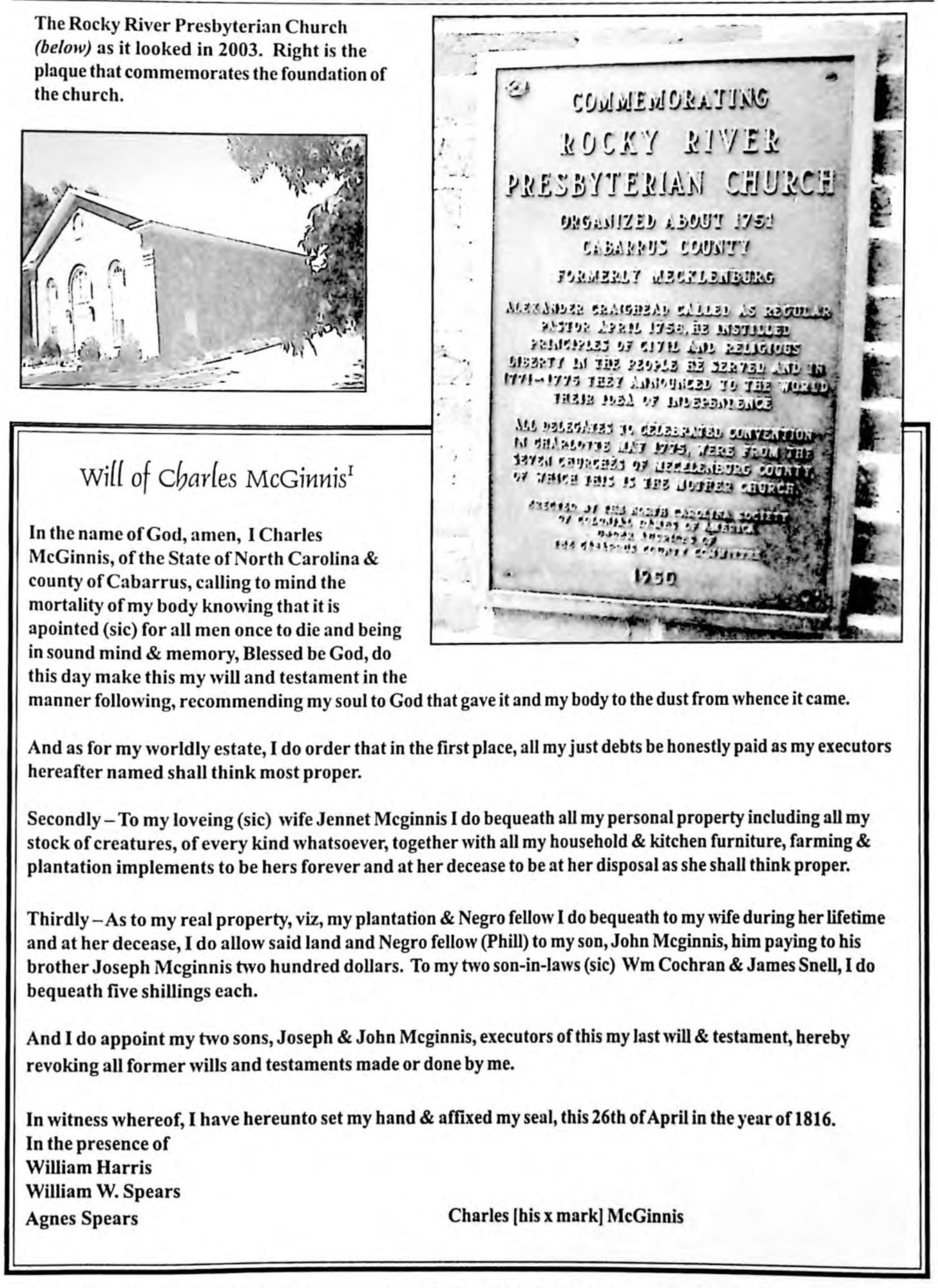
Charles McGinnis died in Cabarrus County, North Carolina sometime between April 1816, when he made his will, and July 1816, when the will was probated. 1816 - James Monroe elected president The will itself is a window into his life at the end.
Charles made his mark-an X-as was common for men of his generation. The will was witnessed by William Harris, William W. Spears, and Agnes Spears.
The Family
From the will and census records, we can piece together Charles’s family:
- Jennet McGinnis (wife) - She inherited all his personal property for life
- John McGinnis (son) - Inherited the land and the slave named Phill, with the obligation to pay his brother Joseph $200. It often is an indication of age order in a family when property is left to only one son who is to pay another. The older son usually got the property, suggesting John was the eldest.
- Joseph McGinnis (son) - To receive $200 from John
- Two daughters (names unknown) - Both were in the household in 1790 but neither was in 1800, indicating that they both married during that decade. Their husbands were William Cochran and James Snell, each bequeathed five shillings.
One of Charles’s daughters married Robert McClelland Cochran, and their daughter Margaret later married back into the McGinnis line. A John McClelland was listed two lines above Charles McGinnis on the 1790 U.S. Census for Mecklenburg County. Another McClelland, Rebecca, was in the same community. It’s likely significant that Margaret named her oldest child “McClelland”-it definitely indicates a connection between the two families.
Where He Rests
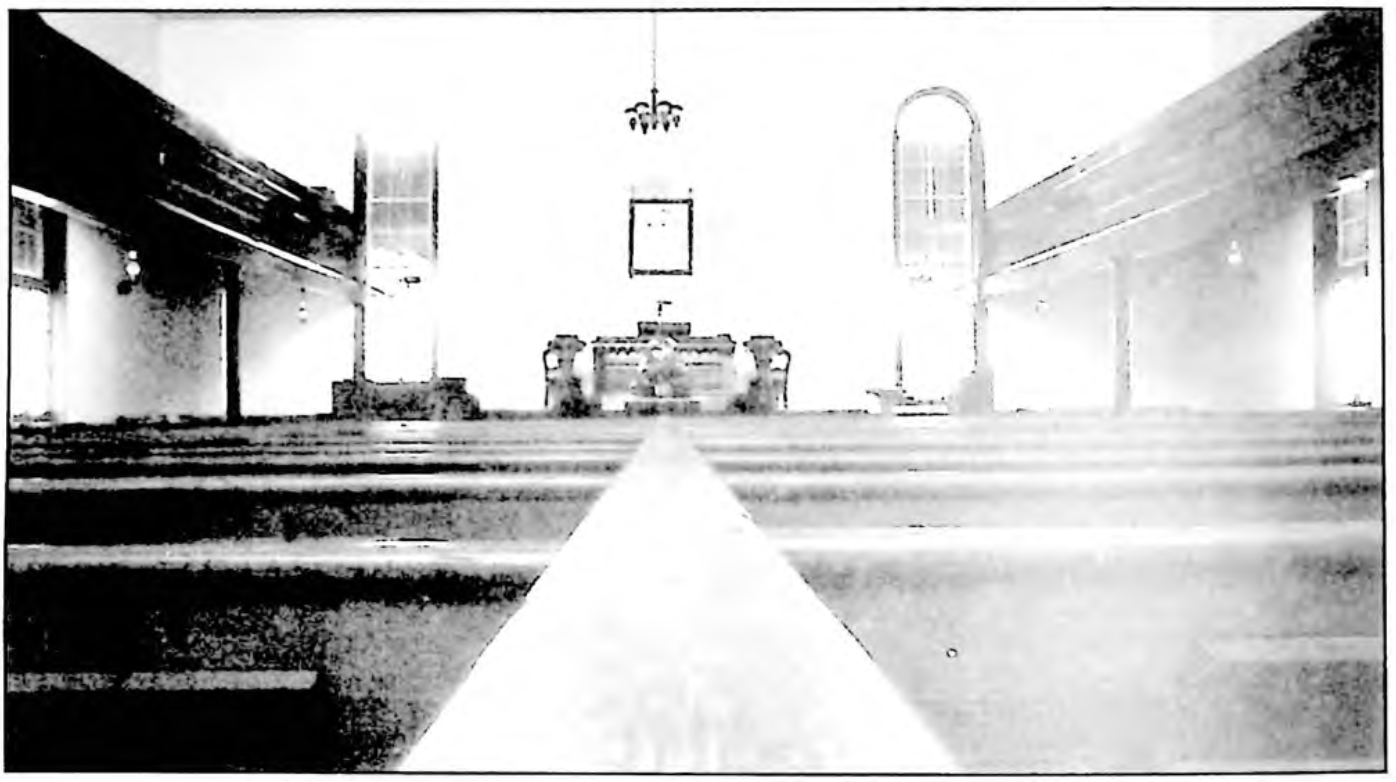 Rocky River Presbyterian Church, organized about 1751, where Charles McGinnis is listed in the early membership rolls.
Old Charles and his wife Jennet likely are buried at Rocky River Presbyterian Church, in the oldest of the graveyards dating from about 1784 to 1845. Many of the graves, including theirs if indeed they are there, are marked only with fieldstones. No carved marker bears his name.
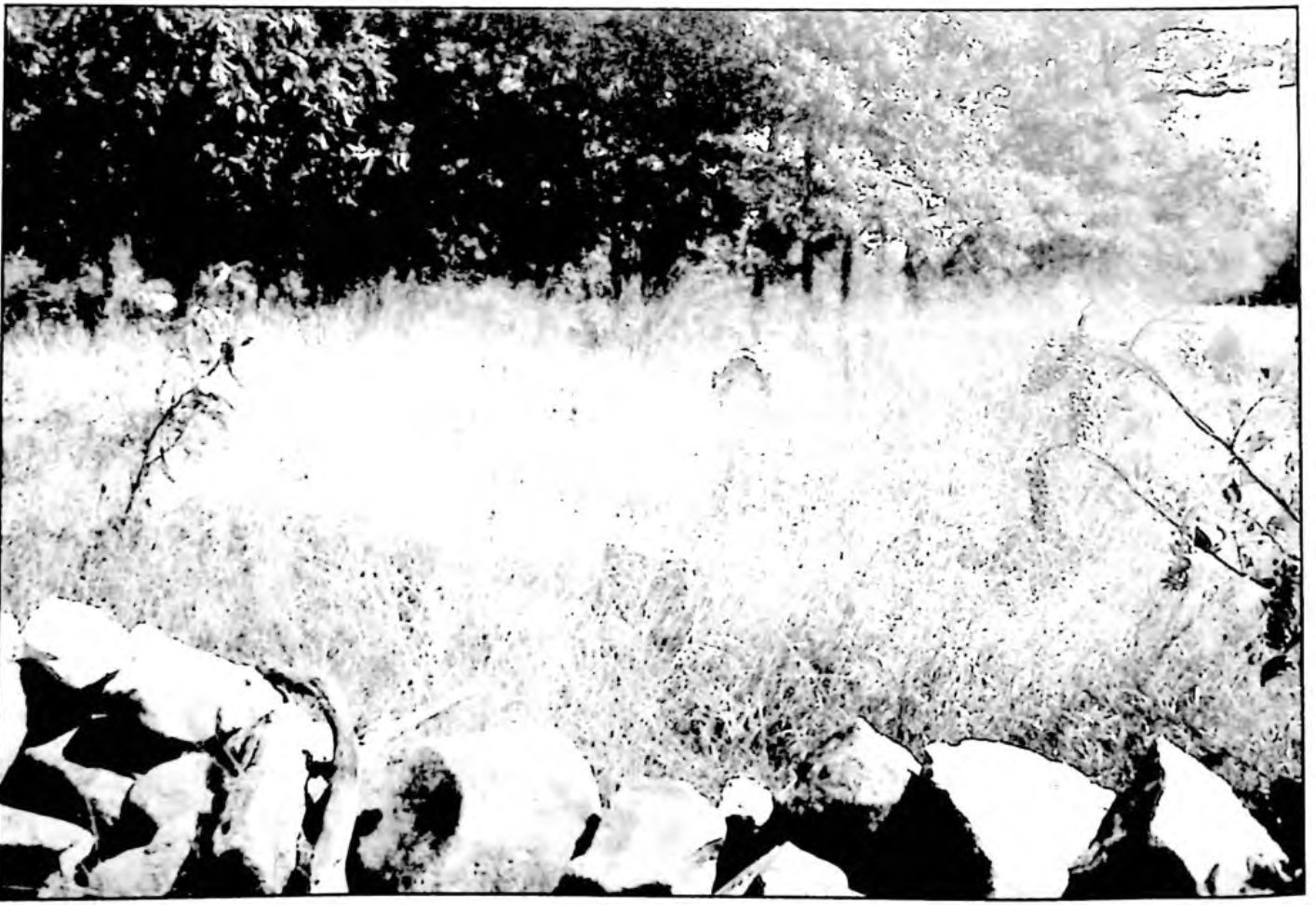 The old graveyard at Rocky River Presbyterian Church, where Charles and Jennet McGinnis likely rest beneath unmarked fieldstones.
This is what we know of Old Charles McGinnis: born in Pennsylvania, possibly a Colonel in the Revolutionary War, a Presbyterian, a landowner, a slaveholder, a man who could not write his own name but who passed land and property to his children. A man who traveled the Great Wagon Road, who settled in the Carolina backcountry and built a life there.
From him, our line descends. His son John would carry the family south to Georgia. And John’s descendants would spread across the American South, building, fighting, dying, and always moving-restless as their Ulster ancestors, hard to turn as their Scots-Irish forebears.
References
Primary Source
McGinnis, Richard W. (2003). 1700-2003 My McGinnis History Begins to Fit: An old Irish family from Ulster comes to North Carolina and then to Georgia. Compiled with assistance from Sharon Tate Moody, CGRS.
Period Journals and Diaries
Spangenberg, August Gottlieb. “Diary of Bishop Spangenberg, 1752.” In Colonial and State Records of North Carolina, Vol. 5. Documenting the American South, UNC Libraries. https://docsouth.unc.edu/csr/index.php/document/csr05-0360. Bishop Spangenberg’s firsthand account of surveying land in North Carolina for the Moravian settlement at Wachovia.
Records of the Moravians in North Carolina. 13 vols. Edited by Adelaide L. Fries et al. Raleigh: North Carolina Historical Commission, 1922-2006. The most complete consecutive historical account of colonial North Carolina, including diaries of the 1753 journey from Bethlehem, PA to establish Bethabara.
Woodmason, Charles. The Carolina Backcountry on the Eve of the Revolution: The Journal and Other Writings of Charles Woodmason, Anglican Itinerant. Edited by Richard J. Hooker. Chapel Hill: UNC Press, 1953. Vivid (if biased) account of backcountry life from an Anglican minister who traveled extensively among Scots-Irish Presbyterians in the 1760s.
The Regulator Movement
“Regulator Movement.” North Carolina Digital Collections, NC Department of Natural and Cultural Resources. https://digital.ncdcr.gov/collections/regulator-movement. Primary documents from the 1768-1771 uprising against corrupt colonial officials.
Husband, Herman. An Impartial Relation of the First Rise and Cause of the Recent Differences in Publick Affairs in the Province of North Carolina (1770). Primary account from a key Regulator leader, including George Sims’s “Address to the People.”
Indigenous Peoples and the Trading Path
Lawson, John. A New Voyage to Carolina (1709). Documenting the American South, UNC Libraries. https://docsouth.unc.edu/nc/lawson/lawson.html. The most comprehensive firsthand account of Carolina’s indigenous peoples in the early colonial period, based on Lawson’s 1701 journey through the Piedmont.
Byrd, William II. History of the Dividing Line Betwixt Virginia and North Carolina (1728). Colonial Williamsburg Digital Library. Byrd’s account of surveying the Virginia-Carolina boundary, with descriptions of the Trading Path and indigenous trade networks.
“Catawba People.” NCpedia, https://www.ncpedia.org/catawba-indians. History of the Catawba Nation, whose ancestral territory included much of the Carolina Piedmont.
“Great Trading Path.” NCpedia, https://www.ncpedia.org/great-trading-path. The indigenous trade route that became the foundation for the Great Wagon Road.
“Occaneechi Indians.” NCpedia, https://www.ncpedia.org/occaneechi-indians. History of the Siouan-speaking peoples who served as trading middlemen along the Great Trading Path.
The Catawba Nation. https://www.catawba.com/about-the-nation. Official website of the Catawba Indian Nation, the only federally recognized tribe in South Carolina.
The Great Wagon Road
Clonts, Forrest W. (1926). “Travel and Transportation in Colonial North Carolina.” North Carolina Historical Review 3 (January 1926). Early academic study of colonial transportation routes.
Cooper, James M. (1995). The Indian Trading Path and Great Wagon Road across North Carolina: Highlighting Rowan and Cabarrus Counties. Detailed study of the road through the McGinnis settlement area.
Crittenden, C. Christopher (1931). “Overland Travel and Transportation in North Carolina, 1763-1789.” North Carolina Historical Review 8 (July 1931). Primary research on colonial road conditions and travel.
“The Great Wagon Road: From Northern Colonies to North Carolina.” NCpedia, https://www.ncpedia.org/waywelived/great-wagon-road. The road was the most important frontier road in North Carolina’s western Piedmont during the eighteenth century.
Settlement of the Piedmont
“Settlement of the Piedmont, 1730-1775.” NCpedia, https://www.ncpedia.org/history/colonial/piedmont. From the 1750s, tens of thousands of German and Scotch-Irish immigrants entered the colony from the north along the road and settled in the western Piedmont.
Fenn, Elizabeth Anne, and Joe A. Mobley (2003). The Way We Lived in North Carolina. Chapel Hill, NC. Comprehensive history of daily life in colonial North Carolina.
North Carolina Census and Land Records
“North Carolina Census Records 1790.” North Carolina Genealogy, https://northcarolinagenealogy.org/census. First federal census available for North Carolina, with Charles McGinnis listed in Mecklenburg County.
“Cabarrus County, North Carolina Genealogy.” FamilySearch, https://www.familysearch.org/en/wiki/Cabarrus_County,_North_Carolina_Genealogy. Cabarrus County Register of Deeds has scanned their deed index books and placed them online, with deed indexes searchable for the years 1791-1982.
“North Carolina Land and Property.” FamilySearch, https://www.familysearch.org/en/wiki/North_Carolina_Land_and_Property. North Carolina Land Grants are available at NC Historical Records Online, covering the period of Charles McGinnis’s land ownership.
The Salzburgers
Barlament, James. “Salzburgers.” New Georgia Encyclopedia, updated Oct 19, 2016.
Jones, George Fenwick. The Salzburger Saga: Religious Exiles and Other Germans Along the Savannah. Athens: UGA Press, 1984.
Urlsperger, Samuel, ed. Detailed Reports on the Salzburger Emigrants Who Settled in America (1733-1741). Translated by Geo. Fenwick Jones et al. Athens: UGA Press, 1968-85.
Chapter Navigation
← Previous: The Crossing | Guide Home | Next: Georgia and the Frontier →