Chapter 4: Georgia and the Frontier (1800-1840)
The new century brought new beginnings. In 1801, John McGinnis-son of Old Charles-married Elizabeth Smith in Cabarrus County, North Carolina. Over the next two decades, they would raise eight children on Carolina soil. But John had inherited his father’s restlessness. By 1826, he was selling everything and heading south.
This chapter follows three generations of McGinnises through the first four decades of the 1800s: John’s move to Georgia and rise to Justice of the Peace, his son Charles W.’s service in the Creek Indian Wars, and the love letters that would lead to the next generation.
Remember the Salzburgers from Chapter 2? Those German Lutheran refugees who crossed the Atlantic in 1734, founded Ebenezer, and built the oldest Lutheran church in America? By the time John McGinnis arrived in Georgia in the late 1820s, the Salzburgers had been there for nearly a century. Their descendants had spread across Effingham and Chatham counties. One of them-Johann Adam Treutlen, who had come to Georgia as an orphaned boy in the original Salzburger party-had become the first elected governor of Georgia in 1777.
The McGinnises knew nothing of the Salzburgers. Why would they? The Salzburgers were German-speaking Lutherans near Savannah; the McGinnises were Scots-Irish Methodists settling DeKalb County, a hundred miles inland. Their worlds did not overlap.
But they would.
1801-1826: Building a Life in Carolina
On January 6, 1801, John married Elizabeth Smith in Cabarrus County, North Carolina. 1801 - Act of Union creates United Kingdom of Great Britain and Ireland His brother Joseph was the bondsman for this marriage, standing up for him as brothers did in those days.
By 1810, John and Elizabeth had six children-three boys and three girls, all under the age of ten. The census shows John as age 26-45, Elizabeth as 16-26. They were building a life in Cabarrus County, on land that had belonged to John’s father Charles.
By 1820, the family had grown to eight children. John was listed as over 45, Elizabeth as 26-45. They were still in Cabarrus, still farming the Carolina soil.
The Land
In 1815, Charles McGinnis had conveyed land to “his son John” by deed-156 acres that John would hold for eleven years. In 1824, John bought 103 more acres from Alexander Pickens, land that adjoined what he already owned. The McGinnises were accumulating property, building something to pass down.
But in 1826, John sold it all. First the 156 acres “formerly owned by Charles McGinnis,” then the land he’d bought from Pickens. The Speers family name was referenced in the deed-the same Speers who had witnessed Old Charles’s will eight years earlier. These families were woven together, witnesses to each other’s lives and deaths and property transfers.
John was preparing to move. South, to Georgia, where land was opening up through lotteries. Where the frontier was still raw and opportunity still beckoned.
1827-1835: Settling DeKalb County
All evidence indicates that John lived in Cabarrus County until the late 1820s, at which time he moved to the Panthersville District of DeKalb County, Georgia. He appeared on the 1810 and 1820 censuses in Cabarrus County, North Carolina, but did not appear on the 1830 or later censuses there.
Instead, in 1830, a John McGinnis appeared in DeKalb County, Georgia. Those in the 1830 DeKalb household are in the appropriate age categories to be the same family as the 1810-1820 families in Cabarrus. He was age 50-60 on the 1830 census. Based on the estimated 1772 birth date for John, he would have been 58 in 1830-right in range.
The original 202½ acres, Land Lot 166 in South DeKalb County that ultimately would be home to John McGinnis and family, was originally land distributed through the 1821 Land Lottery as part of Henry County. 1821 - Georgia Land Lottery distributes former Creek lands John did not participate in this lottery but later bought the land in a private purchase.
Panthersville
The Panthersville area of DeKalb in the late 1820s was rough country. The Wesley Chapel Methodist Church met in a brush arbor in Panthersville until they built a log church shortly after the county was organized. A McGinnis is listed on the roll as a charter member of the “arbor” church. This McGinnis likely was John.
Notice the shift here. Old Charles was Presbyterian, buried (probably) at Rocky River Presbyterian Church in North Carolina. But John joined a Methodist church in Georgia. The Methodist movement was sweeping through the South in this era, and many former Anglicans and even some Presbyterians were joining. Our family was part of that tide.
The Faiths of Our Fathers: A Theological Journey
To understand the McGinnis story-and how it would eventually intersect with the Salzburger story-we need to understand the religious landscape our ancestors navigated. The McGinnises moved through at least three Christian traditions across four generations: Catholic to Presbyterian to Methodist. The Salzburgers remained Lutheran throughout. And hovering over all of them was the Anglican establishment that had driven both families to America in the first place.
These weren’t just denominational labels. They represented fundamentally different answers to the questions that mattered most: How is a person saved? Who has authority over the church? Can you choose God, or does God choose you?
The Catholics: Where the McGinnises Began
The Magennis lords of Iveagh were Catholic-part of the Old Irish order that had ruled County Down for four hundred years before the English conquest. Catholic theology taught that salvation came through the Church: its sacraments, its priests, its traditions stretching back to the apostles. The Pope in Rome held authority over all Christians. Good works mattered-not as a way to earn salvation, but as evidence of a living faith cooperating with God’s grace.
When the Protestant Reformation swept through Europe in the 1500s, Ireland remained Catholic. The English tried to impose Protestantism by force, but the Irish largely resisted. To be Catholic in Ireland was to be Irish; to be Protestant was to be English, the enemy. Faith and national identity became inseparable.
The Magennis family fought alongside other Catholic lords in the Nine Years’ War and the 1641 Uprising. When they lost, they lost everything-land, power, and eventually their faith. Somewhere in the generations that followed, the McGinnises became Presbyterian.
The Presbyterians: The Faith of the Scots-Irish
The Presbyterians who settled Ulster brought a very different theology. They followed John Calvin’s teachings, codified in documents like the Westminster Confession of Faith (1646). At the heart of Calvinist theology was the doctrine of predestination-the belief that God had already determined who would be saved and who would be damned, before the foundation of the world.
The Westminster Confession put it starkly: “By the decree of God, for the manifestation of His glory, some men and angels are predestinated unto everlasting life, and others fore-ordained to everlasting death.” These elect were chosen “out of His mere free grace and love, without any foresight of faith or good works.” God didn’t choose you because He foresaw you would believe; you believed because God chose you.
This might sound grim, but for the Scots-Irish it was actually liberating. If your salvation was already secured by God’s eternal decree, then no bishop, no king, no pope could threaten it. Presbyterians rejected the hierarchical authority of both Catholicism and Anglicanism. Each congregation governed itself. Ministers were elected by the people. Authority came from Scripture alone, not from Rome or Canterbury.
The Presbyterians also rejected the Anglican Book of Common Prayer, preferring extemporaneous preaching and simpler worship. They were serious about education-every believer should be able to read the Bible for themselves. And they were stubborn. The old Scots-Irish prayer captured their character perfectly: “Lord grant that I may always be right, for thou knowst I am hard to turn.”
The Anglicans: The Persecutors
The Church of England-and its Irish branch, the Church of Ireland-occupied a strange middle position. It was Protestant, having broken from Rome under Henry VIII, but it retained much Catholic structure: bishops, elaborate liturgy, hierarchy. Anglicans saw themselves as a via media, a “middle way” between Catholic excess and Calvinist severity.
But for the Scots-Irish Presbyterians in Ulster, the Anglicans were not a moderate middle-they were oppressors. The Penal Laws of the early 1700s discriminated against both Catholics and Presbyterians, forcing both to pay tithes to the established Anglican church. Presbyterian marriages were not legally recognized. Presbyterians were barred from holding public office unless they took communion in the Church of Ireland. They couldn’t attend Trinity College Dublin.
As one historian noted, “For many members of the establishment, Presbyterians were regarded as more of a threat than Catholics, especially because of their numerical superiority.” The Anglicans feared Presbyterian democracy-the idea that congregations could govern themselves threatened the whole structure of monarchy and established church.
This persecution drove the Scots-Irish emigration to America. Between 1717 and 1775, an estimated 200,000 Ulster Presbyterians fled to the colonies, where they could worship freely and govern their own churches. They brought with them a deep suspicion of established religion and hierarchical authority-attitudes that would shape the American Revolution.
The Lutherans: The Salzburger Faith
The Salzburgers who arrived in Georgia in 1734 came from yet another branch of the Reformation. They followed the teachings of Martin Luther, whose central doctrine was justification by faith alone-the belief that salvation comes through faith in Christ’s grace, not through good works or church sacraments.
The Lutheran Augsburg Confession (1530) laid out their beliefs: salvation by faith, the real presence of Christ in communion (though different from Catholic transubstantiation), infant baptism, and freedom of will in civil matters-but not in spiritual ones. Like the Calvinists, Lutherans believed humans were too corrupted by sin to choose God on their own.
But there were differences. Lutherans didn’t emphasize predestination as strongly as Calvinists. They retained more traditional liturgy and church structure. And they tended to be more accepting of secular authority-Luther had famously sided with German princes against peasant revolts.
The Salzburgers were expelled from Catholic Austria for refusing to recant their Lutheran faith. Like the Scots-Irish, they were religious refugees. Like the Scots-Irish, they crossed an ocean to worship freely. They built their Jerusalem Church in Georgia while the McGinnises were building their Presbyterian meeting houses in Carolina. Two Protestant traditions, running parallel, not yet touching.
The Methodists: Where the McGinnises Landed
By the time John McGinnis arrived in Georgia in the late 1820s, a new movement was sweeping the American frontier: Methodism. And this is where the theological story gets interesting.
Methodism began within the Church of England, led by John Wesley in the 1730s. Wesley was an Anglican priest who experienced a dramatic conversion experience and began preaching with a new urgency. He emphasized personal holiness, emotional conversion, and-crucially-free will.
Wesley rejected Calvinist predestination. In his 1739 sermon “Free Grace,” he wrote that predestination “directly tends to shut the very gate of holiness in general.” More bluntly, he called it “blasphemy” and declared that it “represents the most holy God as worse than the Devil, as both more false, more cruel, and more unjust.”
Instead, Wesley taught prevenient grace-the idea that God’s grace is available to everyone, enabling all people to respond to the Gospel if they choose. Salvation wasn’t predetermined; it was offered, and you could accept or reject it. This was Arminianism, named after the Dutch theologian Jacobus Arminius who had challenged Calvin a century earlier.
For frontier families like the McGinnises, Methodism was compelling for several reasons:
It was democratic. Methodist circuit riders went where the people were, preaching in brush arbors, cabins, and open fields. You didn’t need a learned minister with a seminary degree-you needed someone with a fire in their belly and a horse that could handle rough trails.
It was emotional. Camp meetings featured dramatic conversions, shouting, weeping, falling down “slain in the Spirit.” This was a far cry from the formal liturgy of Anglicanism or the intellectual rigor of Presbyterian sermons. It felt real. It felt personal.
It offered hope. If you weren’t predestined-if salvation was genuinely available to anyone who would accept it-then the Gospel was truly good news for everyone, not just the elect. On the frontier, where death could come suddenly from disease, accident, or Indian attack, this mattered.
It was practical. Wesley emphasized not just conversion but sanctification-the lifelong process of becoming holy. Methodists formed small groups called “classes” where members held each other accountable. This created tight-knit communities on a frontier where community was essential for survival.
Between 1770 and 1820, American Methodists grew from fewer than 1,000 members to more than 250,000. In 1775, one in 800 Americans was Methodist; by 1812, it was one in 36. Half of this growth came from circuit riders and camp meetings.
Georgia’s first recorded camp meeting was held on Shoulderbone Creek in Hancock County in 1803. Circuit riders crisscrossed the frontier, some preaching 20 sermons a week. Half of them died before reaching age 33-the same age as Christ. This was a demanding ministry for a demanding faith.
When John McGinnis joined Wesley Chapel Methodist Church in Panthersville, he was joining this movement. His father had been Presbyterian, believing in God’s sovereign election of the saints. John chose a faith that said he could choose God-that grace was freely offered and freely accepted. It was a theological shift that matched the democratic, frontier spirit of the new nation.
What They Shared
For all their differences, these Protestant traditions shared certain core beliefs that would have been recognizable to any of our ancestors:
Scripture as authority. Catholics looked to Scripture and Church tradition; Protestants looked to Scripture alone (sola scriptura). But all agreed the Bible was God’s Word.
Salvation through Christ. However they disagreed about predestination or free will, all believed Jesus Christ was the only path to salvation.
The importance of community. Whether in a Catholic parish, a Presbyterian session, a Lutheran congregation, or a Methodist class meeting, faith was practiced in community.
A call to holy living. Catholics, Calvinists, and Methodists alike believed that faith should transform behavior. Works didn’t save you, but saved people did good works.
The McGinnises and the Salzburgers both came to America as Protestant refugees, fleeing persecution by established churches. They both built communities of faith in the wilderness. They both passed their traditions down through generations. And two centuries after they arrived-when Richard McGinnis married Shirley Long in 1953-those two traditions finally merged into one family.
The Children in Georgia
John and Elizabeth Smith McGinnis had at least eight children. By the time they settled in Georgia, several were grown or nearly so:
- A daughter (born 1802-1804)
- Joseph L. McGinnis (born about 1805)
- Charles W. McGinnis (born August 16, 1808, Cabarrus County, NC) - Our direct line
- Two more daughters (born 1804-1810)
- John S. McGinnis (born about 1810)
- Two more sons (born 1810-1820)
Charles W. likely came to DeKalb County with his parents between 1827 and 1830. He was probably the youngest male child in the household of John McGinnis in DeKalb County in 1830.
1832-1835: John Becomes Justice of the Peace
John became a man of some standing in his new community. In 1832, he was a fortunate drawer in the Gold Lottery, winning Lot 34 in District 16. 1831 - Nat Turner’s slave rebellion in Virginia In November of that same year, he reported to the Inferior Court on the survey of a new road in the Panthersville District. Along with Lodowick Tuggle and James Hunt, John reported on the best route for a new road from Decatur to Swinney’s. This road likely is the current Wesley Chapel Road.
By 1835, John McGinnis was shown as a Justice of the Peace for General Militia District 536, the Panthersville Militia District, in DeKalb County. 1835 - Halley’s Comet visible; Samuel Colt patents the revolver
What Was a Justice of the Peace?
In the 1830s, Georgia’s frontier communities were still wild and sparsely settled. DeKalb County had fewer than 10,000 residents scattered across farms and hamlets in 1830. Much of the area had only recently been ceded by Native Americans, and untamed nature pressed close to the new homesteads. Panthers still prowled the swamps-one legendary big cat killed near Panthersville was said to measure “11 feet from tip to tip.” In such raw country, formal law enforcement was scarce. Keeping order often fell to local militia and officials like the Justice of the Peace, who served as the nearest judge and peacemaker on the frontier.
The Justice of the Peace was a low-level magistrate with authority over minor legal matters. Georgia’s 1798 state constitution had created JP courts specifically to handle minor civil cases, relieving higher courts of trivial disputes. Every militia district was assigned its own justices-typically two per district-elected by their neighbors and charged with “keeping the peace.” A man chosen as a JP gained a measure of status; people might call him “Squire” as a sign of respect. One Georgia writer joked that nearly every older man had been a justice of the peace at some point, earning the lifelong title.
John’s duties would have been varied. On one day he might convene a “court of conscience” on a neighbor’s porch or at a crossroads store to settle a small debt or a quarrel over a stray cow. JP courts had jurisdiction over petty crimes and minor civil disputes. If two farmers argued over a property line or accused each other of trespass, it was John’s job to hear testimony and render a commonsense judgment. He could order one party to pay damages or fine a troublemaker for disturbing the peace. For more serious offenses outside his authority, he could issue arrest warrants and hold preliminary hearings, binding over accused felons to await trial in the county superior court. John was the first stop for justice on the frontier: accessible, informal, but backed by the authority of the state.
Beyond judging disputes, a Justice of the Peace performed civil functions that knit the community together. He could administer official oaths and witness documents-useful in a land of few lawyers. Most famously, JPs officiated weddings. Frontier Georgia often lacked ordained ministers nearby, so couples turned to the local justice to solemnize their marriage. Georgia law explicitly authorized JPs to marry people with “the same authority as a Minister,” and in practice justices of the peace and country preachers conducted far more weddings than judges did. John would have been called upon to pronounce bride and groom as husband and wife at cabins and farmhouses, then sign the marriage certificate and return it to the courthouse.
His responsibilities didn’t end with court cases and weddings. Georgia’s county governments relied on justices of the peace to help run local affairs. In DeKalb County, all the JPs together sat as the county’s Inferior Court, which handled administration: maintenance of jails, building of roads, care of the poor, and other civic business. This meant John would have a voice in decisions about infrastructure and public welfare-which explains why we see him in 1832 reporting on the best route for a new road, a duty that dovetailed with his later role as JP. The Inferior Court also handled tasks like overseeing orphans’ estates and county finances.
Picture John McGinnis in 1835 riding along a muddy trail to hold court or to conduct a wedding under the Georgia pines. The frontier was gradually giving way to organized society, and he was one of the men making that possible. Armed with a ledger book, a copy of Georgia law, and the trust of his neighbors, “Squire” McGinnis helped bridge the gap between rough-and-tumble frontier life and the rule of law. For the son of a man who once could not even sign his own name, rising to serve as a Justice of the Peace marked a remarkable climb.
1836: The Creek Indian Wars
In early 1836, trouble was brewing. 1836 - Second Creek War (Creek Indian Wars) The Creek and Seminole Indians in Alabama began crossing the Chattahoochee River and attacking Georgia citizens. The DeKalb militia, the DeKalb Light Infantry, was ordered to be ready to march in defense of the citizens of this area. In less than a month, the company was ready and eager to serve in defense against the Indians.
John’s son, Charles W. McGinnis, now 27 years old, was the 1st Lieutenant in this militia, second to Dr. Ezekial N. Calhoun who held the rank of Captain.
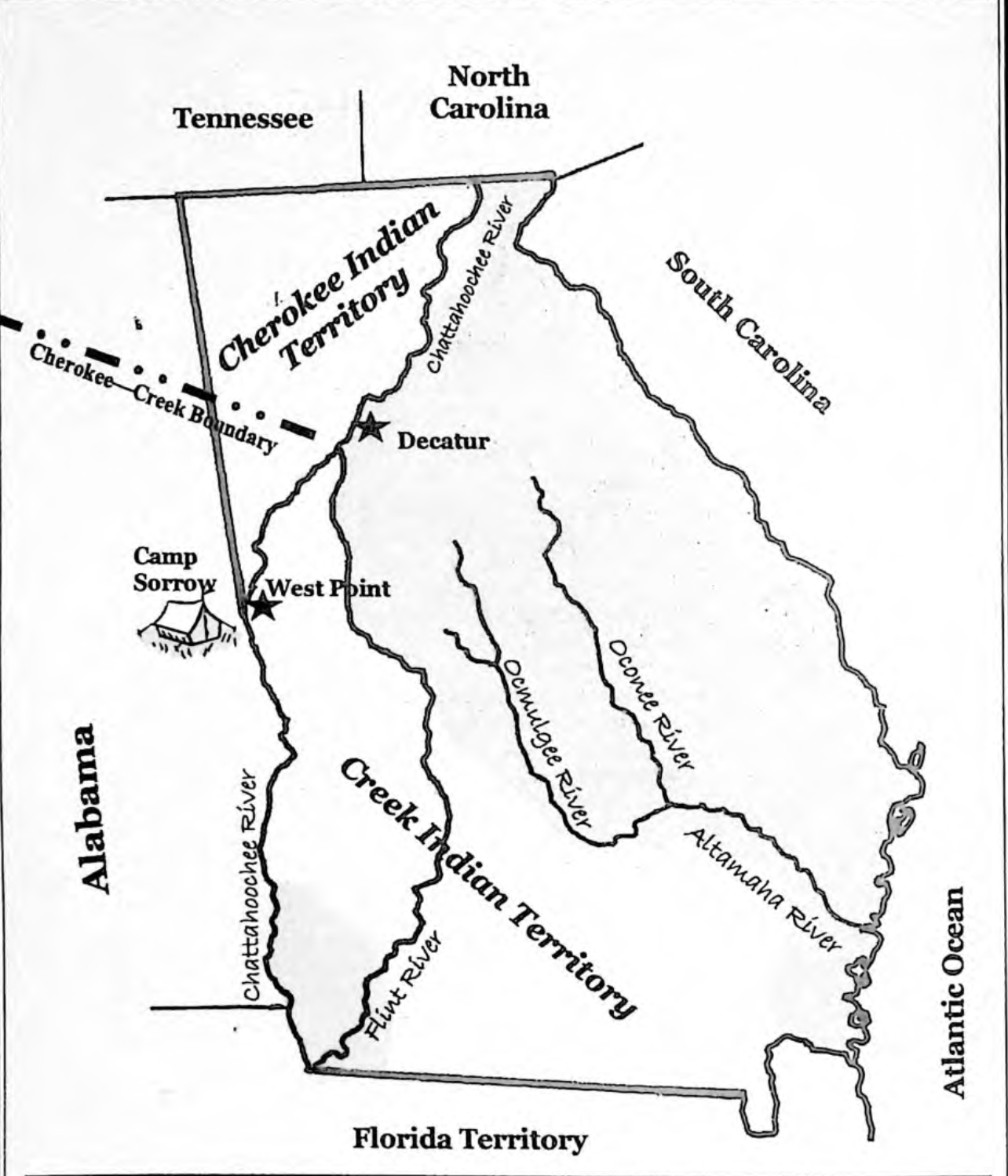
What They Were Marching Into
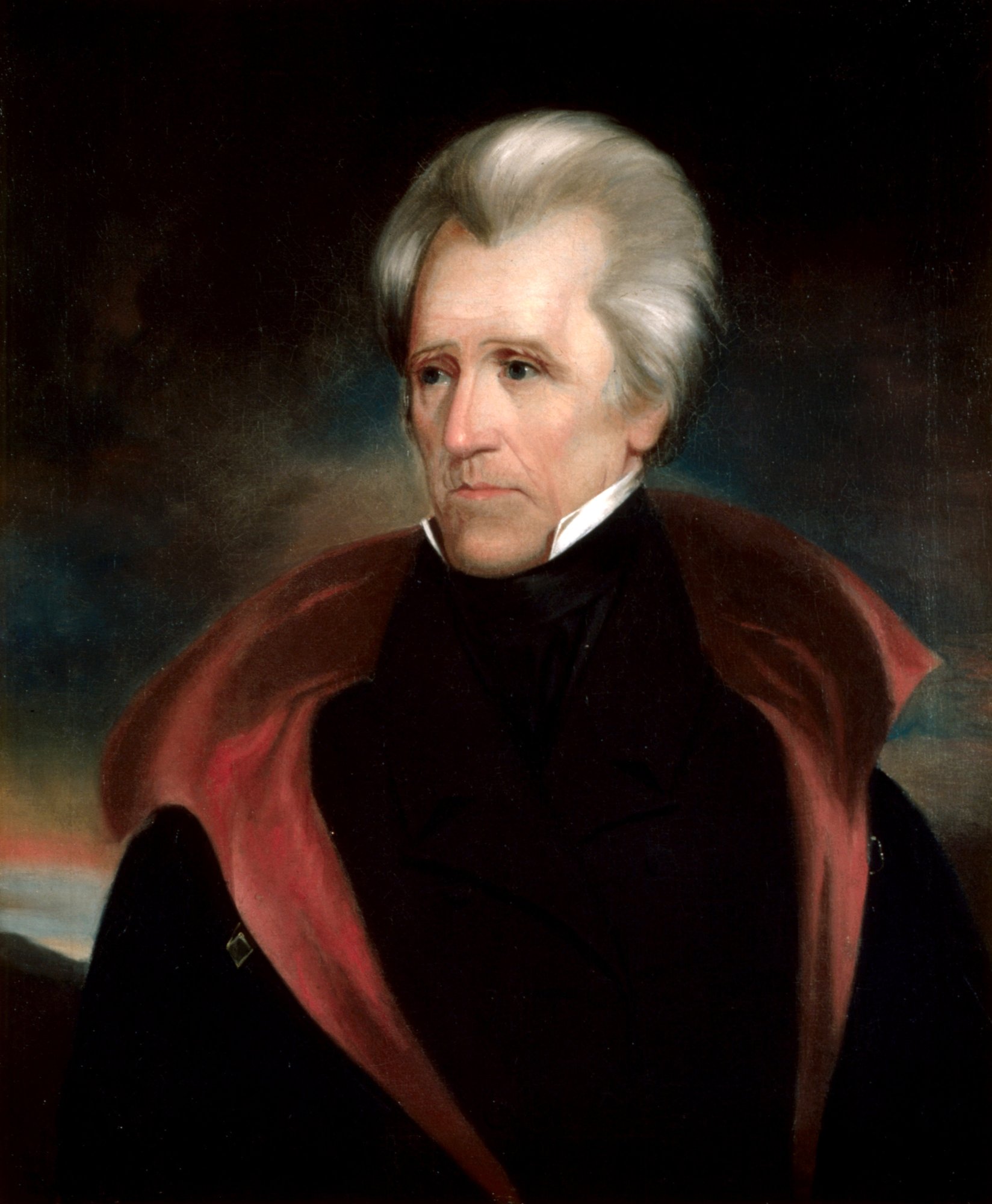 Andrew Jackson (1767-1845), whose Indian removal policy led to the 1836 Creek War and the forced deportation of the Muscogee people.
The 1836 conflict-the Second Creek War-was the final, desperate resistance of the Muscogee (Creek) people against Andrew Jackson’s Indian removal policy. For years, Creeks had been subjected to fraud and land theft under the 1832 Treaty of Cusseta. Now, faced with forced deportation to Oklahoma, a faction of Lower Creeks rose in armed resistance rather than be driven from their ancestral homes.
On May 14, 1836, just weeks before the McGinnis brothers marched, a war party of several hundred Creek warriors struck the Georgia river town of Roanoke without warning. In a pre-dawn assault, they overwhelmed the small garrison. Out of about twenty defenders, only six survived. The warriors burned Roanoke to the ground, erasing it from the map entirely. News of the “Roanoke massacre” spread panic through every settlement along the Chattahoochee. Families abandoned farms and fled to stockade forts while militia units from multiple counties rushed toward the danger zone.
For the McGinnis brothers in their DeKalb militia company, Roanoke’s fate made the war terrifyingly real.
The largest battle occurred on June 9, 1836, at Shepherd’s Plantation in Stewart County. Captain Hamilton Garmany’s Georgia militia had established an encampment there, unaware that hundreds of Creek fighters had gathered silently in the nearby swamps. When Garmany unwisely divided his troops that morning, the Creeks seized the moment. With a sudden war whoop, about 250 warriors stormed out of the woods and attacked from front and flank, catching the Georgians in a deadly crossfire.
The battle was desperate and bloody. Garmany’s men fell back in disarray, nearly overrun, until reinforcements from a nearby fort hit the attackers on their flank. After half an hour of close-quarters combat, the warriors withdrew. Even with help arriving, the militia suffered 22 casualties-most killed outright.
By late June, U.S. Army troops under General Winfield Scott had crushed the uprising. The defeated Creek Nation was now at the mercy of Jackson’s removal policy. Thousands of Creek men, women, and children were rounded up at bayonet-point and herded into internment camps. From there, they were forced to march 750 miles to Oklahoma in what Creeks remember as their own Trail of Tears. Of roughly 15,000 Creeks deported in 1836-37, more than 3,500 died en route from disease, exposure, and starvation.
The Second Creek War was short-lived, but it provided Jackson the final pretext for the wholesale removal of the Muscogee people from the Southeast. For Georgia’s white settlers, including the McGinnis family, these events were remembered as the closing of a dangerous chapter. For the Creeks, it was an irreparable loss of homeland and life.
Standing Peachtree: The Ground Beneath Our Feet
There’s a personal dimension to this history that makes it impossible to keep at arm’s length. The Standing Peachtree area-where Peachtree Creek meets the Chattahoochee River-was a Muscogee village called Pakanahuili long before Atlanta existed. Today, Will McGinnis and his family live just a few hundred feet from that site.
In the 18th century, Standing Peachtree marked a key trading nexus on the border between Creek and Cherokee territories. The Chattahoochee was the boundary line, with a Cherokee settlement just across the water. Centuries of Native trade had forged the Peachtree Trail, which ran from this village northeast through the forests into the Cherokee mountains. Portions of today’s Peachtree Road trace this very route.
During the War of 1812, Georgia erected Fort Peachtree on high ground overlooking the Creek village-a crude log stockade with a two-story blockhouse. It was the first U.S. military post in what is now Atlanta. The fort’s purpose was to guard the river passage, and the wagon path connecting it to other forts became the original Peachtree Road, which would later evolve into Atlanta’s famous Peachtree Street.
The Creeks’ hold on this land ended through the 1821 Treaty of Indian Springs-engineered by Georgia agents and signed by a faction of Lower Creek chiefs, most infamously William McIntosh, who was later executed by his own people for this betrayal. After thousands of years, indigenous title to the Chattahoochee-Peachtree confluence was extinguished. The area was surveyed into land lots, distributed by lottery, and Standing Peachtree became the first official post office in DeKalb County in 1825.
It’s worth pausing on the timeline here. When John McGinnis arrived in DeKalb County around 1827, the Treaty of Indian Springs was only six years old. The land he bought had been Creek land within living memory. The trails his sons walked to muster for war had been walked by Creek traders and hunters just a generation before. This wasn’t ancient history-it was immediate, and it was violent.
When Charles W. McGinnis and his brothers marched west in 1836, the old Peachtree Road would have brought them northward toward that very river bend before turning toward the fighting beyond. They likely knew Standing Peachtree as a local landmark. Perhaps they paused at Montgomery’s Ferry to cross the Chattahoochee, hearing the creak of the raft and the rush of the river. Little could they have imagined that one day their descendants might live on that very spot.
Today, Standing Peachtree Park is a small leafy park in Atlanta’s Buckhead area, surrounded by modern homes. Visitors can stand on a bluff above the wide Chattahoochee and read a plaque about the Creek village that once thrived there. For the McGinnis family-living within earshot of this historic ground-such facts are more than dry history. They are the prologue to a family story that stretches back nearly 200 years on this same land.
The Letters to Mary
One of the ways Charles passed his time in camp was to write letters to the girl back home. He was very much enamored with Miss Mary E. Hawkins of Decatur, as evidenced by his lovesick letters.
The letters are remarkable. They are tender, funny, observant, frustrated, homesick, and deeply in love. They show us Charles in a way no census record or land deed ever could. Here was a man who could write beautifully, who noticed preachers with epaulets, who was tired of eating bread and meat, who kissed a lock of hair again and again, who wanted his girl to have “something good” ready when he got home.
From West Point, June 28, 1836
Sweet beloved & affectionate Mary.
You will think verry strange when you receive this letter so shortly after my writing once to you but you requested me to write to you every opertunity. I should have done this had you not made this request. Mary I love you two dearly not to write you when I have a chance. This is five letters I have wrote to you since I left home. You stated to me you had received but one. That was the one I sent by Mr. Buckhanan. I wrote one to you when we was at Newnan as we came down here. I have written three since we came here besides this one. The last one I wrote the other day & sent by Mr. Pool. I know you will get it and I am in hopes you will get all of them.
He goes on to tell her about camp life, about his health, about waiting on officers to make decisions:
…I went to preaching the other day and saw what I never have before. Do you want to know what that is? I guess its how you do & saw a preacher get up in the pulpit to preach with an epalet on his shoulder. It looked very curious. We have four or five Methodists preachers in our camps and have preaching a lot.
And then, with the straightforward honesty that marks all his letters:
You must have something good for us to eat when we come home for I tell you my dear friend I am verry tired of eating bread and meat.
From Camp Sorrow, August 1, 1836
This letter is longer, more detailed, written when Charles was recovering from illness and tending to a sick comrade:
I hope I never will [address you any other way than as friend and lover]. I received your kind, friendly and affectionate letter Saturday morning and o how glad I was to see it and still more so when I read it. I must return you ten thousands thanks for your kindness to me and I am in hopes I will be able to reward you for it all if we should live.
You are the best and sweetest friend I have on his earth though I know [unreadable] some time ago. I am happy to inform you yes thrice happy that my health has improved veny much since I wrote to you last. I have got able to discharge my duty in camp which I do feel very thankful to god the giver of all blessings.
Smith is lying veny sick at this time with the measles. He has been confined nine days but I am in hopes the worst is over with him. They have broke out on him. I am veny much fatigued night and day tending on him. I was just able to walk about when he was taken down.
A Father Visits His Son at War
Then comes a remarkable moment. In August 1836, 64-year-old John McGinnis-Justice of the Peace, landowner, patriarch-rode to an Alabama war camp to visit his son.
I was very glad to see my father. Yes, Mary I was overcome with joy when he came in camp and o if I surly could see you I cannot tell how glad I would be. But you can tell if you know how glad you would be to see me.
It’s a remarkable image: John McGinnis riding to Camp Sorrow as a civilian-much too old to serve in the militia himself-but compelled to see his boy. What did they talk about in that camp? Did John tell Charles about the land in Georgia, about being Justice of the Peace, about how far they’d come from that Carolina farm? Did he warn him about the dangers ahead? Did he just want to see him alive one more time?
We don’t know. We just know he rode there, and Charles noted it in a letter to the girl back home.
The Lock of Hair
And then this moment, so tender it aches:
When I opened your letter and found the lock of your precious hair that you sent me I kissed it and kissed it and kissed it again. I thought if I only could see your lovely face it would do me more good than any thing in this world.
The letter closes with military business mixed with love:
I fear there is about fifty cases of measles in our company. Now you must be certain and write to me again yes my sweet friend Mary. It affords me so much pleasure to get a letter from you dearly I must close by subscribing myself your sincere lover until death. I love to write our names but I would rather see you than to look at your name.
Miss M. L. Hawkins C. W. McGinnis
The Man in the Letters
These letters give us Charles in full color. He was educated enough to write well, though his spelling was phonetic and his punctuation creative. He was a Methodist-those preachers in camp were his people. He was dutiful, tending to his sick friend Smith even when barely recovered himself. He was sensitive to military protocol, frustrated when Captain Jones left him in command while he was “not verry able for it yet.”
He was homesick and lovesick in equal measure. He counted the letters he’d written to Mary (nine or ten by August) and noted she hadn’t written as many back. He wanted her to write more. He wanted good food. He wanted to see her “lovely face.”
And through it all, there’s humor. The preacher with the epaulet. Mr. Pickens telling Charles that Mary was “a beautiful girl” and Charles replying, “tell me something I did not know.” The way he repeats himself for emphasis: “no no no no every time.”
This is the Irish personality Richard McGinnis would describe in himself 167 years later: storyteller, social, observant of details, a bit wordy. The genes running true.
1836-1840: After the War
Charles came home from the Creek Indian Wars. He married Mary E. Hawkins. They settled in Decatur, where Charles would build a life.
Meanwhile, John McGinnis-now in his late 60s-made one more move. Between 1830 and 1840, he moved from DeKalb County to Cherokee County, Alabama. Apparently, he and his son John made the move together. He appeared on the 1840 Census in Cherokee County between the ages of 60-70 with a female 40-50 and two younger females in his household.
The census data suggests John may have married a second time. The oldest female in the household in 1830 and 1840 appears to be a different woman than Elizabeth Smith, who was likely his first wife and the mother of his first eight children. She probably died between 1820 and 1830, and John married again.
John does not appear on the 1850 census in Cherokee, so it is likely that he died between 1840 and 1850, somewhere in Alabama, far from the North Carolina land his father had settled.
Restless to the end. Always moving. The Ulster blood, the Scots-Irish wanderlust, still running strong.
John McGinnis had done what his father did: moved south in search of better land, better opportunity. From Pennsylvania (probably) to North Carolina, his father had traveled the Great Wagon Road. From North Carolina to Georgia, John continued the journey. And even in his sixties, he moved again, to Alabama.
But his son Charles W. stayed in Georgia. Charles had found something worth staying for: Mary Hawkins, the girl who sent him a lock of her hair, the girl he promised to love “until death.”
They would have children. One of those children-John William-would carry on the family name. And John William would march off to another war, a generation later, and this time the McGinnis soldier would not come home.
References
Primary Source
McGinnis, Richard W. (2003). 1700-2003 My McGinnis History Begins to Fit: An old Irish family from Ulster comes to North Carolina and then to Georgia. Compiled with assistance from Sharon Tate Moody, CGRS.
Georgia Settlement and Migration
“County History: DeKalb County, Georgia.” DeKalb History Center, https://dekalbhistory.org/exhibits-dekalb-history-center-museum/dekalb-county-history/. The settlers who came into DeKalb were of English, Scotch, and Irish descent coming from Virginia, the Carolinas, and Europe.
“Colonial Immigration.” New Georgia Encyclopedia, https://www.georgiaencyclopedia.org/articles/history-archaeology/colonial-immigration/. The people who came to Georgia after the American Revolution were mainly Scots-Irish and German, arriving in America between 1720 and 1770.
“MIGRATION AND SETTLEMENT IN EARLY GEORGIA.” Georgia Archives, https://www.georgiaarchives.org/assets/documents/MigrationL+L_Watermark.pdf. The 1821 land lottery, which raffled off land taken from the Creeks, resulted in the formation of Henry, Fayette and Gwinnett Counties, from which DeKalb County would eventually be formed.
The Creek War
“The Creek War of 1813-1814.” American Battlefield Trust, https://www.battlefields.org/learn/articles/creek-war-1813-1814. The Creek War erupted on the southern frontier from 1812-1813, with American settlers pushing into Creek homelands of western Georgia and Alabama.
“Creek War of 1813-14.” Encyclopedia of Alabama, https://encyclopediaofalabama.org/article/creek-war-of-1813-14/. Tennessee governor Willie Blount directed Major General Andrew Jackson to mobilize a force to suppress the Creeks, with authorities in Georgia and Mississippi also planning offensives.
The Second Creek War (1836)
“Second Creek War (1836-37).” Encyclopedia of Alabama, https://encyclopediaofalabama.org/article/second-creek-war-1836-37/. Context on the causes of the 1836 Creek uprising and its aftermath.
“Second Creek Indian War.” Fort Wiki. Summary of the war’s timeline, including the attack on Roanoke (May 14, 1836) and Creek removal statistics.
Cox, Dale. “The Battle of Roanoke, Georgia.” Explore Southern History. Narrative description of the Roanoke massacre where Creeks destroyed the town and killed most defenders.
Cox, Dale. “The Battle of Shepherd’s Plantation.” Explore Southern History. Detailed account of the June 9, 1836 battle in Stewart County, highlighting the ambush of Capt. Garmany’s militia and the 22 casualties suffered.
Standing Peachtree
Butler, Will. “Atlanta Streets: Path to Peachtree Street, U.S.A.” Atlanta History Center (UnderCurrent). History of Standing Peachtree, Fort Peachtree’s construction in 1814, and the old Peachtree Trail/Road connection.
Garrett, Franklin M. Atlanta and Environs (1954). Documents the cession of Creek lands by the 1821 Treaty of Indian Springs and the establishment of Standing Peachtree as the first DeKalb County post office.
Justice of the Peace and Frontier Governance
Digest of the Laws of the State of Georgia. Various editions, 1820s-1830s. Milledgeville, GA: Camak & Ragland. Primary source for the legal authority of Justices of the Peace, their jurisdiction over minor civil and criminal cases, authority to issue warrants, administer oaths, and solemnize marriages.
Georgia Constitution of 1798. Established the framework for county courts and Justices of the Peace, including their election at the militia district level and their role in adjudicating minor disputes.
Hitz, Alexia Jones. The Georgia Judiciary: History and Structure. Atlanta: Georgia Administrative Office of the Courts. Secondary source detailing the evolution of Justice of the Peace courts, their jurisdiction, and their function within Georgia’s early judicial system.
Smith, James F. Early Courts and Lawyers of Georgia. Atlanta: Foote & Davies Co., 1909. Descriptive accounts of Justice of the Peace courts, informal proceedings, and anecdotes illustrating frontier legal culture.
Knight, Lucian Lamar. Georgia’s Landmarks, Memorials, and Legends, Vol. 2. Atlanta: Byrd Printing Co., 1914. Source for frontier anecdotes, including Panthersville traditions, settlement patterns, and cultural memory of early DeKalb County.
DeKalb County, Georgia. Inferior Court Minutes and Road Records, 1820s-1830s. DeKalb County Courthouse Archives, Decatur, GA. Primary records documenting Justices of the Peace serving on Inferior Courts, including road surveys, civic duties, and militia district governance.
Religious History and Theology
Presbyterian Theology and the Westminster Confession
“The Westminster Confession of Faith.” Ligonier Ministries, https://learn.ligonier.org/articles/westminster-confession-faith. The 1646 confession codifying Calvinist theology, including predestination.
“Of God’s Eternal Decree.” Westminster Confession of 1646, Blue Letter Bible, https://www.blueletterbible.org/study/ccc/westminster/Of_Gods_Eternal_Decree.cfm. Primary text of Chapter 3 on predestination.
“Presbyterianism in the Eighteenth Century.” Ulster Historical Foundation, https://ulsterhistoricalfoundation.com/the-scots-in-ulster/from-ulster-to-america/presbyterianism. Context on Presbyterian faith in Ulster and emigration to America.
Methodist Theology and John Wesley
Wesley, John. “Sermon 58: On Predestination.” The Wesley Center Online, https://wesley.nnu.edu/john-wesley/the-sermons-of-john-wesley-1872-edition/sermon-58-on-predestination/. Wesley’s Arminian response to Calvinist predestination.
Wesley, John. “Predestination Calmly Considered.” Society of Evangelical Arminians, https://evangelicalarminians.org/wp-content/uploads/2013/03/Wesley.-PREDESTINATION-CALMLY-CONSIDERED.pdf. Wesley’s extended theological argument for free will.
Pedlar, James. “John Wesley on Predestination.” https://jamespedlar.ca/2012/02/16/john-wesley-on-predestination/. Analysis of Wesley’s two main concerns about Calvinist theology.
Methodist Growth and Camp Meetings
“Revivals and Camp Meetings.” New Georgia Encyclopedia, https://www.georgiaencyclopedia.org/articles/arts-culture/revivals-and-camp-meetings/. Georgia’s first camp meeting at Shoulderbone Creek (1803) and the spread of revival culture.
“Camp Meetings & Circuit Riders: Frontier Revivals.” Christian History Institute, https://christianhistoryinstitute.org/uploaded/50cf81cc64f6c0.60843690.pdf. Methodist growth from 1,000 to 250,000 members between 1770-1820.
“Circuit rider (religious).” Wikipedia, https://en.wikipedia.org/wiki/Circuit_rider_(religious). The demanding life of frontier Methodist preachers.
Lutheran Theology and the Salzburgers
“The Augsburg Confession.” Evangelical Lutheran Synod, https://els.org/beliefs/augsburgconfession/. The 1530 confession defining Lutheran theology.
“Lutheran Church.” New Georgia Encyclopedia, https://www.georgiaencyclopedia.org/articles/arts-culture/lutheran-church/. Lutheran history in Georgia from the Salzburger settlement.
“Salzburgers.” New Georgia Encyclopedia, https://www.georgiaencyclopedia.org/articles/history-archaeology/salzburgers/. The theological background of the Georgia Salzburgers.
Anglican Persecution of Presbyterians
“Penal laws (Ireland).” Wikipedia, https://en.wikipedia.org/wiki/Penal_laws_(Ireland). Laws discriminating against Catholics and Presbyterians in favor of the Anglican establishment.
“Religion in Eighteenth-Century America.” Library of Congress, https://www.loc.gov/exhibits/religion/rel02.html. Overview of colonial American religious landscape.
Image Credits
Andrew Jackson portrait via Wikimedia Commons. Public domain. Original painting by Thomas Sully (1824), National Gallery of Art.
Chapter Navigation
← Previous: The Great Wagon Road | Guide Home | Next: The Civil War →