TrueSkill: Microsoft's Rating System for Xbox Live
We’ve explored Elo and the Glicko family of rating systems so far. Now it’s time to dive into a more modern approach: Microsoft’s TrueSkill system.
Developed for Xbox Live matchmaking, TrueSkill represents a significant advancement in rating system design, incorporating Bayesian inference to handle uncertainty in a sophisticated way.
The Origin Story: From Chess to Xbox
TrueSkill was developed by Microsoft Research for use in Xbox Live’s matchmaking service. Development began around 2005-2006, with the formal algorithm published in 2007 (Herbrich et al.). It was designed to address several limitations of existing rating systems:
- The need to handle team-based games, not just 1v1 matches
- The challenge of accurately rating players after very few games
- The desire to create balanced, enjoyable matches for players of all skill levels
- The ability to handle matches with more than two players or teams
While Elo and Glicko were designed primarily for chess, TrueSkill was built from the ground up for modern video games, where players might participate in team-based competitions, free-for-all matches, or other complex competitive formats.
How TrueSkill Works: Bayesian Skill Modeling
TrueSkill takes a fundamentally different approach than Elo or Glicko. Rather than representing a player’s skill as a single number, it models skill as a probability distribution:
Each player’s skill is represented by a Gaussian (normal) distribution with two parameters:
- μ (mu): The mean, representing the player’s estimated skill
- σ (sigma): The standard deviation, representing uncertainty about that estimate
After each match, both parameters are updated using Bayesian inference:
- μ changes based on match outcome (win/loss)
- σ decreases as more information is gathered (more games played)
For matchmaking, TrueSkill uses a “conservative” skill estimate:
- Matchmaking Rating = μ - 3σ
- This ensures players are matched based on a conservative lower bound of their skill
This approach allows TrueSkill to be cautious with new players (high σ) while quickly adapting as more information becomes available.
Implementing TrueSkill with Elote
Let’s see how TrueSkill works in practice with Elote:
from elote import TrueSkillCompetitor

# Create two competitors
player_a = TrueSkillCompetitor()
player_b = TrueSkillCompetitor()

# Check initial ratings
print(f"Initial ratings - Player A: μ={player_a.mu}, σ={player_a.sigma}")
print(f"Initial ratings - Player B: μ={player_b.mu}, σ={player_b.sigma}")

# Record a match result
player_a.beat(player_b)

# See how ratings changed
print(f"After Player A beats Player B - Player A: μ={player_a.mu}, σ={player_a.sigma}")
print(f"After Player A beats Player B - Player B: μ={player_b.mu}, σ={player_b.sigma}")
Notice how both μ and σ change after the match. Player A’s μ increases (indicating higher skill) while their σ decreases (indicating more certainty). The opposite happens for Player B.
Visualizing TrueSkill: Conservative Rating Updates
One of TrueSkill’s key features is its conservative approach to rating updates. Let’s visualize this:
import matplotlib.pyplot as plt
import numpy as np
import os

# Create players with different experience levels
new_player = TrueSkillCompetitor()  # Default μ=25, σ=8.33
experienced_player = TrueSkillCompetitor(mu=25, sigma=2)  # Same skill, but more certain

# Record initial ratings
new_player_ratings = [(new_player.mu, new_player.sigma)]
experienced_player_ratings = [(experienced_player.mu, experienced_player.sigma)]

# Simulate a series of matches where the new player wins
for _ in range(10):
    new_player.beat(experienced_player)
    new_player_ratings.append((new_player.mu, new_player.sigma))
    experienced_player_ratings.append((experienced_player.mu, experienced_player.sigma))

# Plot the results
plt.figure(figsize=(12, 6))

# Plot μ changes
plt.subplot(1, 2, 1)
plt.plot([r[0] for r in new_player_ratings], label='New Player μ')
plt.plot([r[0] for r in experienced_player_ratings], label='Experienced Player μ')
plt.xlabel('Number of Matches')
plt.ylabel('μ (Skill Estimate)')
plt.title('TrueSkill μ Changes Over Time')
plt.legend()
plt.grid(True, alpha=0.3)

# Plot σ changes
plt.subplot(1, 2, 2)
plt.plot([r[1] for r in new_player_ratings], label='New Player σ')
plt.plot([r[1] for r in experienced_player_ratings], label='Experienced Player σ')
plt.xlabel('Number of Matches')
plt.ylabel('σ (Uncertainty)')
plt.title('TrueSkill σ Changes Over Time')
plt.legend()
plt.grid(True, alpha=0.3)

plt.tight_layout()

# Save the figure
project_root = os.path.abspath(os.path.join(os.path.dirname(__file__), '..', '..'))
output_dir = os.path.join(project_root, 'static', 'images', 'elote', '04-trueskill-rating-system')
os.makedirs(output_dir, exist_ok=True)
plt.savefig(os.path.join(output_dir, 'conservative_updates.png'))
plt.close()
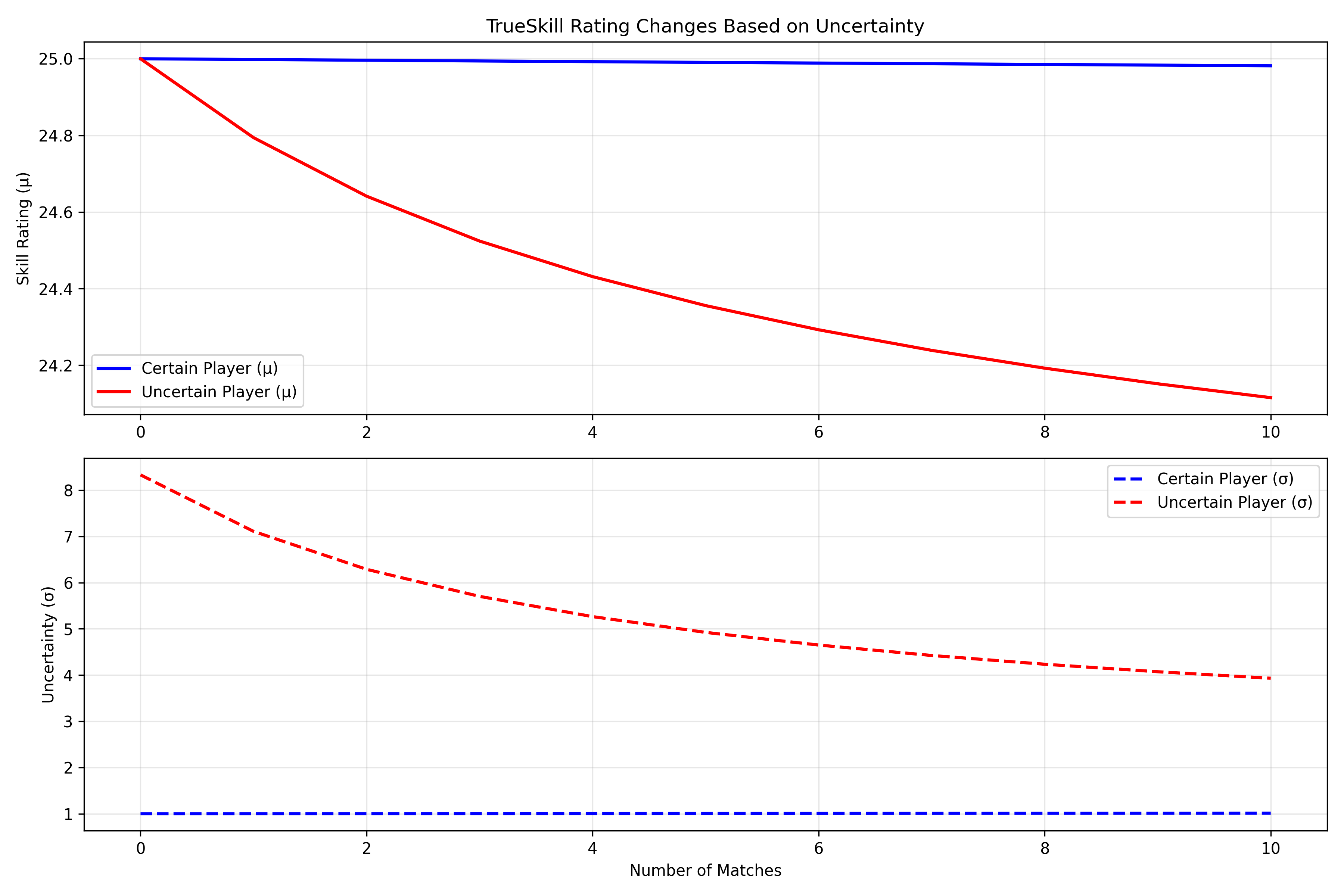
This visualization shows how TrueSkill updates ratings differently based on uncertainty. The new player’s rating changes more dramatically than the experienced player’s, even though they have the same outcomes. This is because TrueSkill is more cautious with established players (low σ) than with new players (high σ).
Simulating a Tournament with TrueSkill
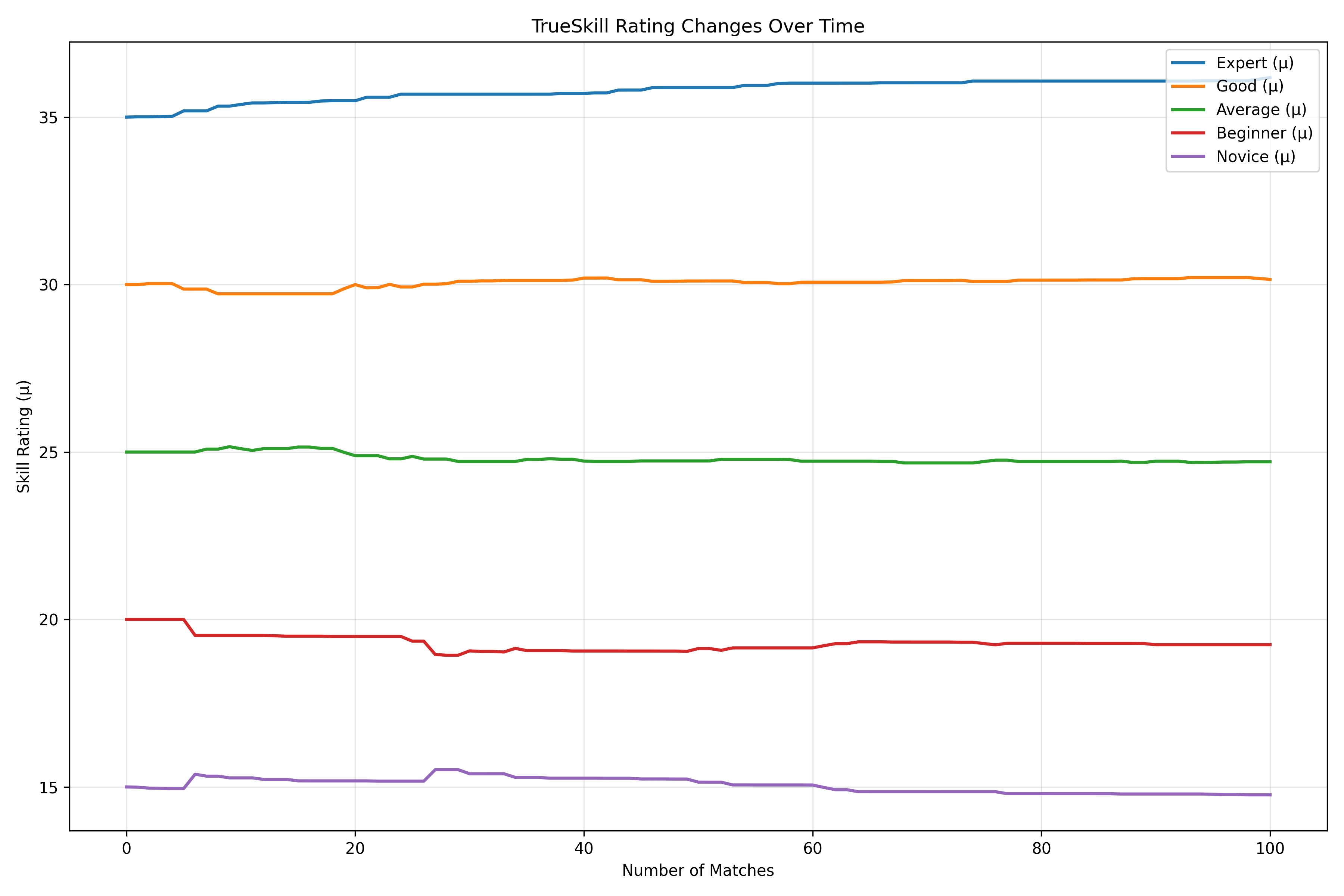
Let’s see how TrueSkill performs in a tournament setting:
import random
import numpy as np
import matplotlib.pyplot as plt
import os

# Create competitors with different skill levels
skill_levels = {
    "Expert": 35,
    "Good": 30,
    "Average": 25,
    "Beginner": 20,
    "Novice": 15
}

# Create competitors
competitors = {}
for name, skill in skill_levels.items():
    competitors[name] = TrueSkillCompetitor(mu=skill, sigma=8.33)

# Function to simulate matches based on true skill
def simulate_comparison(a, b):
    # Add some randomness to true skill
    a_performance = skill_levels[a] + random.normalvariate(0, 3)
    b_performance = skill_levels[b] + random.normalvariate(0, 3)
    return a_performance > b_performance

# Create all possible matchups
matchups = [(a, b) for a in skill_levels for b in skill_levels if a != b]

# Track ratings over time
rating_history = {name: [(competitors[name].mu, competitors[name].sigma)] for name in skill_levels}

# Run the tournament
for i in range(100):  # 100 matches
    # Pick a random matchup
    a, b = random.choice(matchups)

    # Determine the winner based on true skill
    if simulate_comparison(a, b):
        competitors[a].beat(competitors[b])
    else:
        competitors[b].beat(competitors[a])

    # Record ratings after every 20 matches
    if (i+1) % 20 == 0:
        print(f"After {i+1} matches:")
        for name in skill_levels:
            mu = competitors[name].mu
            sigma = competitors[name].sigma
            print(f"{name}: μ = {mu:.2f}, σ = {sigma:.2f}")
            rating_history[name].append((mu, sigma))

# Plot the rating changes
plt.figure(figsize=(12, 8))

# Plot μ changes
plt.subplot(2, 1, 1)
for name, history in rating_history.items():
    plt.plot([h[0] for h in history], label=f"{name}")
plt.xlabel('Tournament Progress (20-match intervals)')
plt.ylabel('μ (Skill Estimate)')
plt.title('TrueSkill μ Changes During Tournament')
plt.legend()
plt.grid(True, alpha=0.3)

# Plot σ changes
plt.subplot(2, 1, 2)
for name, history in rating_history.items():
    plt.plot([h[1] for h in history], label=f"{name}")
plt.xlabel('Tournament Progress (20-match intervals)')
plt.ylabel('σ (Uncertainty)')
plt.title('TrueSkill σ Changes During Tournament')
plt.legend()
plt.grid(True, alpha=0.3)

plt.tight_layout()

# Save the figure
plt.savefig(os.path.join(output_dir, 'sigma_changes.png'))
plt.close()
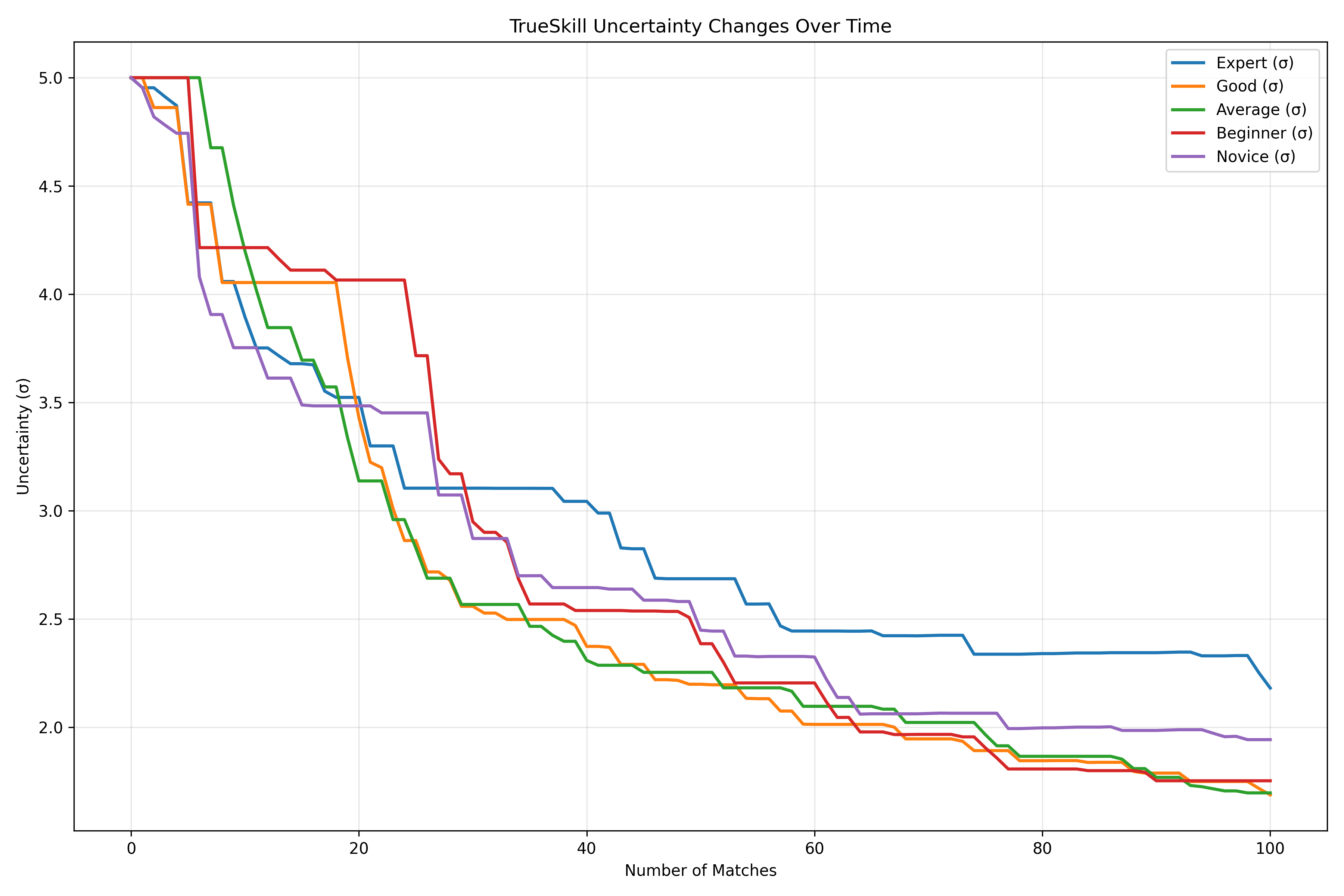
This simulation shows how TrueSkill ratings evolve during a tournament. Notice how the uncertainty (σ) decreases for all players as more matches are played, while the skill estimates (μ) converge toward the true skill levels.
Real-World Example: Valorant Player Rankings
Let’s use TrueSkill to rank players in a competitive game like Valorant, where different player roles can have synergies:
import random
import matplotlib.pyplot as plt
import numpy as np
import os

# Valorant players with different roles
valorant_players = [
    "Sentinel_Sam",     # Defensive specialist
    "Duelist_Dana",     # Entry fragger
    "Controller_Chris", # Smoke/vision control
    "Initiator_Ivy",    # Information gatherer
    "Flex_Felix",       # Versatile player
    "Sniper_Sarah",     # AWP specialist
    "Lurker_Larry",     # Flanker
    "IGL_Ian"           # In-game leader
]

# Simulate player matchups with role synergies
def simulate_comparison(a, b):
    # Base skill levels
    base_skills = {
        "Sentinel_Sam": 85,
        "Duelist_Dana": 90,
        "Controller_Chris": 82,
        "Initiator_Ivy": 88,
        "Flex_Felix": 86,
        "Sniper_Sarah": 92,
        "Lurker_Larry": 84,
        "IGL_Ian": 80  # Lower mechanical skill but great leadership
    }

    # Role synergy bonuses (simplified)
    role_synergies = {
        "Sentinel_Sam": ["Controller_Chris", "IGL_Ian"],
        "Duelist_Dana": ["Initiator_Ivy", "Controller_Chris"],
        "Controller_Chris": ["Duelist_Dana", "Sentinel_Sam"],
        "Initiator_Ivy": ["Duelist_Dana", "Lurker_Larry"],
        "Flex_Felix": ["IGL_Ian", "Sniper_Sarah"],
        "Sniper_Sarah": ["Sentinel_Sam", "Flex_Felix"],
        "Lurker_Larry": ["Initiator_Ivy", "IGL_Ian"],
        "IGL_Ian": ["Flex_Felix", "Sentinel_Sam", "Lurker_Larry"]
    }

    # Calculate synergy bonus
    a_bonus = 5 if b in role_synergies[a] else 0
    b_bonus = 5 if a in role_synergies[b] else 0

    # Simulate performance with some randomness
    a_performance = base_skills[a] + a_bonus + random.uniform(-10, 10)
    b_performance = base_skills[b] + b_bonus + random.uniform(-10, 10)

    return a_performance > b_performance

# Create matchups
matchups = []
for _ in range(100):  # 100 random matchups
    a = random.choice(valorant_players)
    b = random.choice([p for p in valorant_players if p != a])
    matchups.append((a, b))

# Create competitors
competitors = {player: TrueSkillCompetitor() for player in valorant_players}

# Run the tournament
for player_a, player_b in matchups:
    if simulate_comparison(player_a, player_b):
        competitors[player_a].beat(competitors[player_b])
    else:
        competitors[player_b].beat(competitors[player_a])

# Display rankings
print("Valorant Player Rankings (TrueSkill):")
sorted_players = sorted(competitors.items(), key=lambda x: x[1].mu - 3*x[1].sigma, reverse=True)
for i, (player, competitor) in enumerate(sorted_players):
    print(f"{i+1}. {player}: μ={competitor.mu:.2f}, σ={competitor.sigma:.2f}, Rating={competitor.mu - 3*competitor.sigma:.2f}")

# Compare different ranking methods
ranking_methods = {
    "μ only": [(p, c.mu) for p, c in competitors.items()],
    "μ - σ": [(p, c.mu - c.sigma) for p, c in competitors.items()],
    "μ - 2σ": [(p, c.mu - 2*c.sigma) for p, c in competitors.items()],
    "μ - 3σ": [(p, c.mu - 3*c.sigma) for p, c in competitors.items()]
}

# Sort each ranking method
for method, ratings in ranking_methods.items():
    ranking_methods[method] = sorted(ratings, key=lambda x: x[1], reverse=True)

# Plot the different rankings
plt.figure(figsize=(12, 8))
methods = list(ranking_methods.keys())
x = np.arange(len(valorant_players))
width = 0.2
offsets = np.linspace(-0.3, 0.3, len(methods))

for i, method in enumerate(methods):
    # Get ranks (position in sorted list)
    ranks = {p: r+1 for r, (p, _) in enumerate(ranking_methods[method])}
    # Plot in original player order for consistency
    plt.bar(x + offsets[i], [ranks[p] for p in valorant_players], width, label=method)

plt.xlabel('Players')
plt.ylabel('Rank (lower is better)')
plt.title('TrueSkill: Comparing Different Ranking Methods')
plt.xticks(x, valorant_players, rotation=45)
plt.yticks(np.arange(1, len(valorant_players)+1))
plt.gca().invert_yaxis()  # Invert y-axis so rank 1 is at the top
plt.legend()
plt.tight_layout()

# Save the figure
plt.savefig(os.path.join(output_dir, 'ranking_methods.png'))
plt.close()
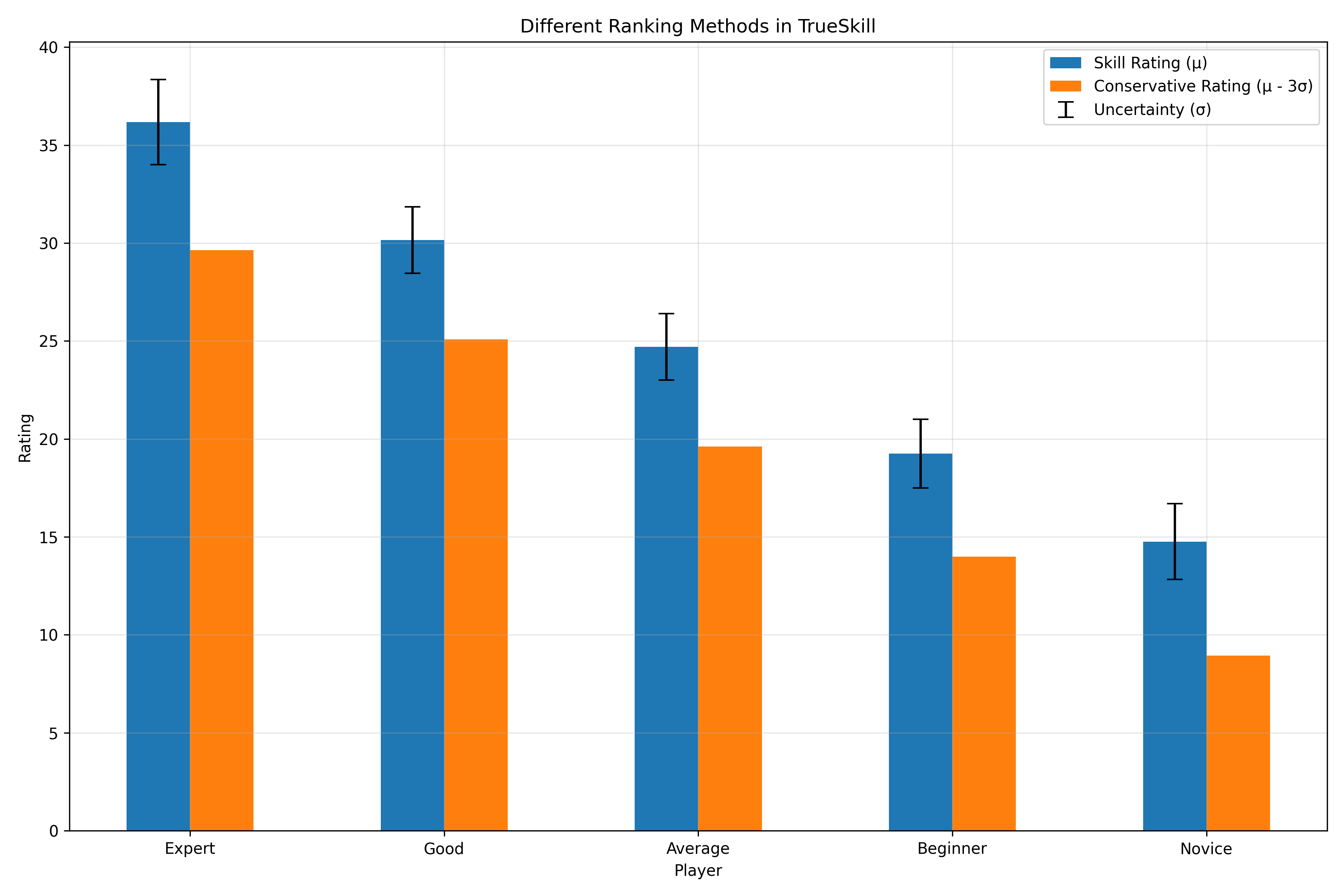
This example shows how TrueSkill can be used to rank players in a competitive game, taking into account different roles and synergies. The visualization compares different ranking methods, from using just μ (optimistic) to μ - 3σ (conservative).
Win Probability in TrueSkill
TrueSkill can also calculate the probability of one player beating another:
import matplotlib.pyplot as plt
import numpy as np
import os

# Create a range of skill differences
mu_diffs = np.arange(-15, 16, 1)
sigma_values = [1, 2, 4, 8]
win_probs = {}

# Calculate win probability for different sigma values
for sigma in sigma_values:
    win_probs[sigma] = []
    for mu_diff in mu_diffs:
        player_a = TrueSkillCompetitor(mu=25, sigma=sigma)
        player_b = TrueSkillCompetitor(mu=25 + mu_diff, sigma=sigma)
        win_probs[sigma].append(player_a.expected_score(player_b))

# Plot the results
plt.figure(figsize=(10, 6))
for sigma, probs in win_probs.items():
    plt.plot(mu_diffs, probs, label=f'σ = {sigma}')

plt.axhline(y=0.5, color='r', linestyle='--', alpha=0.5)
plt.axvline(x=0, color='r', linestyle='--', alpha=0.5)
plt.grid(True, alpha=0.3)
plt.xlabel('μ Difference (Player A - Player B)')
plt.ylabel('Probability of Player A Winning')
plt.title('TrueSkill Win Probability vs. Skill Difference')
plt.legend()

# Save the figure
plt.savefig(os.path.join(output_dir, 'win_probability.png'))
plt.close()

# Now let's look at rating changes
mu_diffs = np.arange(-15, 16, 1)
rating_changes = []

for mu_diff in mu_diffs:
    player_a = TrueSkillCompetitor(mu=25, sigma=4)
    player_b = TrueSkillCompetitor(mu=25 + mu_diff, sigma=4)

    # Record initial rating
    initial_mu = player_a.mu

    # Player A wins
    player_a.beat(player_b)

    # Record rating change
    rating_changes.append(player_a.mu - initial_mu)

# Plot the results
plt.figure(figsize=(10, 6))
plt.plot(mu_diffs, rating_changes)
plt.axhline(y=0, color='r', linestyle='--', alpha=0.5)
plt.axvline(x=0, color='r', linestyle='--', alpha=0.5)
plt.grid(True, alpha=0.3)
plt.xlabel('μ Difference (Opponent - Player)')
plt.ylabel('μ Change After Win')
plt.title('TrueSkill Rating Change vs. Skill Difference')

# Save the figure
plt.savefig(os.path.join(output_dir, 'trueskill_rating_changes.png'))
plt.close()
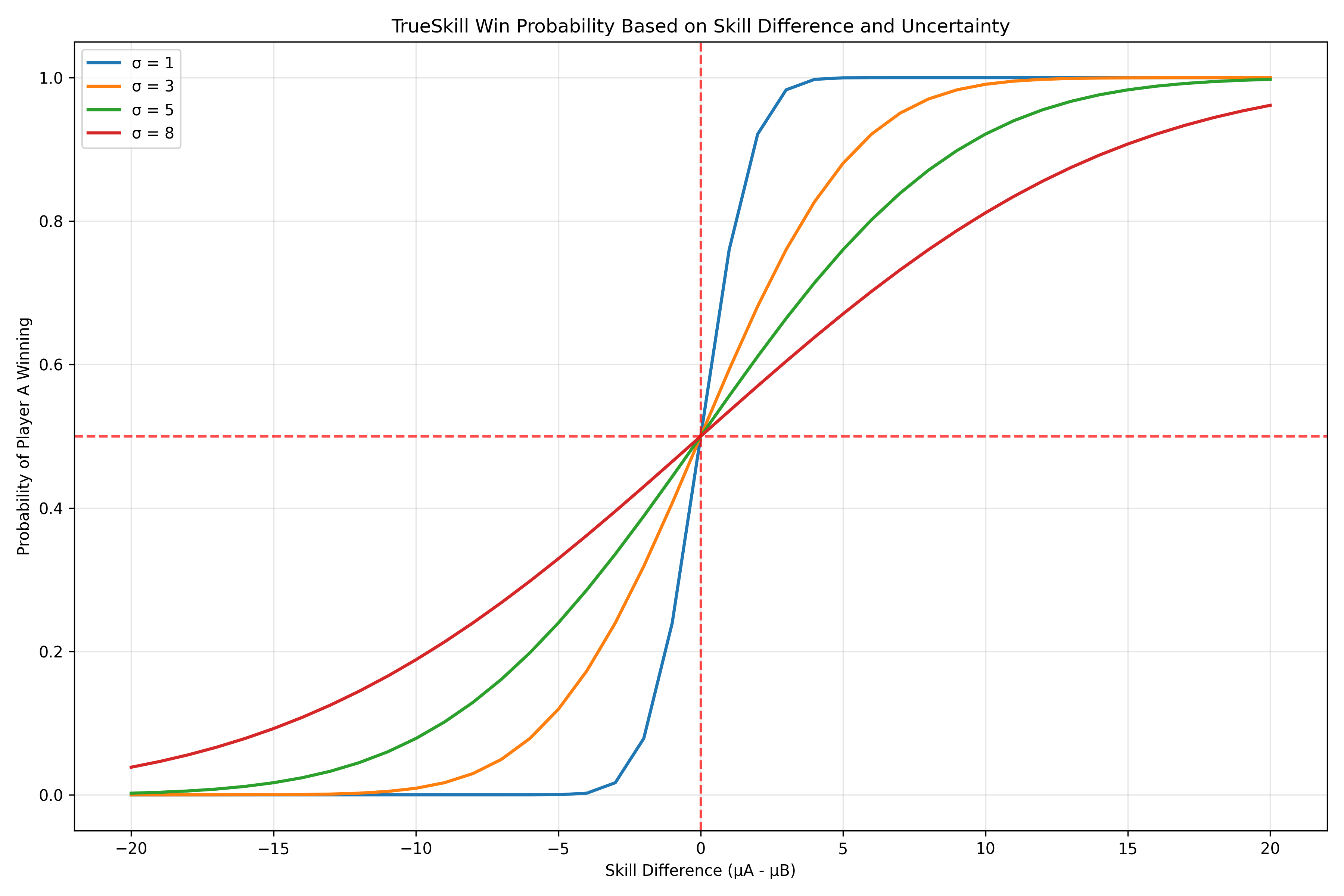
These visualizations show how TrueSkill calculates win probabilities and rating changes. Notice how the uncertainty (σ) affects the win probability curve - higher uncertainty leads to a flatter curve, reflecting less confidence in the outcome prediction.
Pros and Cons of TrueSkill
Pros:
- Uncertainty tracking: Explicitly models confidence in skill estimates
- Fast convergence: Reaches accurate ratings with fewer games
- Team support: Designed for team games, not just 1v1
- Conservative matchmaking: Prevents frustrating mismatches
- Bayesian foundation: Mathematically rigorous approach
Cons:
- Complexity: More complex than Elo or Glicko
- Computational cost: More expensive to calculate
- Less intuitive: Harder to explain to non-technical users
- Proprietary origins: Originally developed as a proprietary system
- Parameter sensitivity: Results can be sensitive to parameter choices
When to Use TrueSkill
TrueSkill is best when:
- You need to rate players after very few games
- You’re dealing with team-based competitions
- You want to create balanced matchmaking
- You need to handle matches with more than two players/teams
- You have the computational resources for more complex calculations
Conclusion: The Modern Bayesian Approach
TrueSkill represents a significant advancement in rating system design, bringing Bayesian methods to bear on the problem of skill estimation. Its sophisticated uncertainty handling makes it particularly well-suited for modern gaming environments, where players expect fair matchmaking from their very first game.
While more complex than earlier systems, TrueSkill’s benefits often outweigh its costs, especially in contexts where player retention depends on creating balanced, enjoyable matches.
In our next post, we’ll explore the ECF (English Chess Federation) rating system, which takes a completely different approach to the rating problem.
Until then, may your μ rise and your σ fall!
Stay in the loop
Get notified when I publish new posts. No spam, unsubscribe anytime.